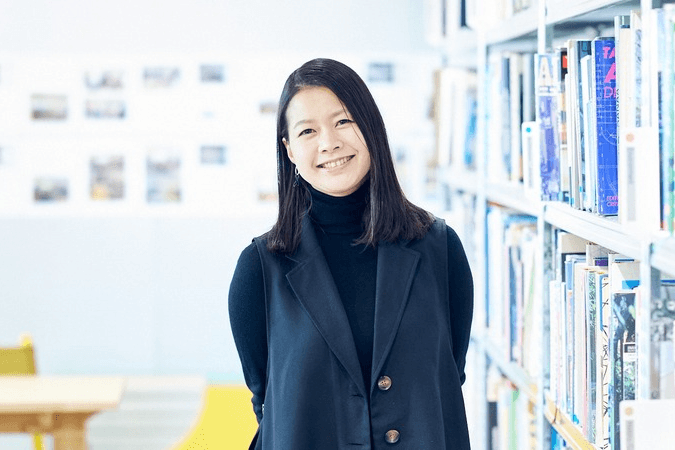
Sayaka Koga is a spatial designer who excels at communication-centered spatial concept design and is active in a wide range of fields as an all-around player. Since joining the company, Koga has been committed to concept design experiences, and she talks about the appeal of working at NOMURA Co.,Ltd. and what she has valued in her work.
I primarily handle spatial concept design centered on communication. My concept design focus is on "experience."
Koga belongs to concept design Department 3 of the First concept design Center in the Creative Division. Currently, as Room Chief, she is leading various projects with her team members.
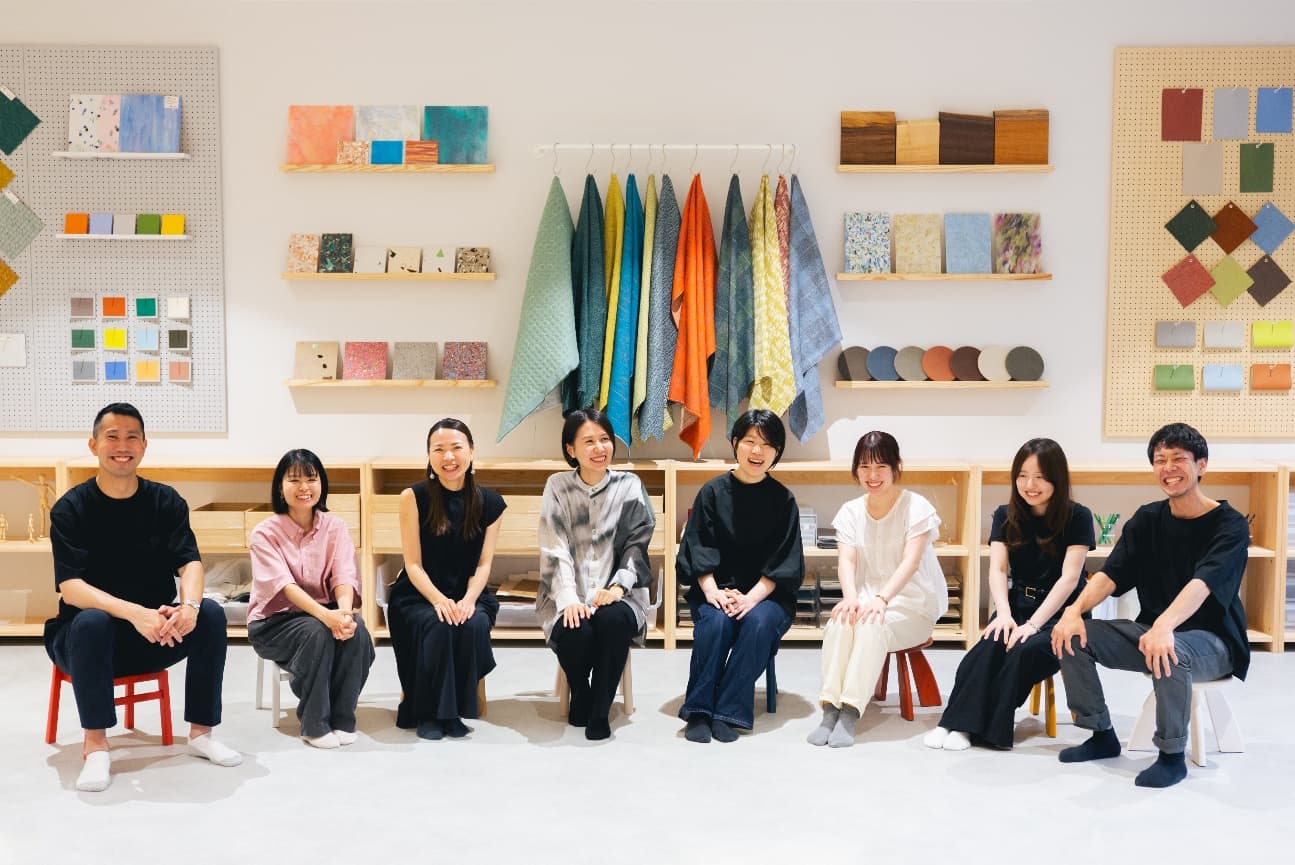
Koga: "While many teams specialize in specific areas, our team handles a wide range of projects, including offices, commercial facilities, showrooms, and displays."
Another difference from other concept design teams is that we are often involved from the initial planning stages. Based on the idea that the role of concept design is to understand the client's challenges and solve them, we are involved in projects from the concept creation phase."
Koga's specialty is spatial concept design centered on communication. He says that thoroughly gathering information through repeated interviews and then translating that into concept design is an essential part of his work.
Koga: "For example, in a multi-store project where I'm in charge of concept design concept and flagship store concept design, I'm focusing on communication with local people as a key theme, and working to create a space where local people can drop by more casually, not just to buy products."
There are many things we can only understand by directly listening to customers and store staff, or by visiting the site ourselves. The basic concept design involves exchanging opinions with many people, picking up on their problems and key phrases, and then drawing inspiration from that to elevate it into spatial concept design."
Currently, Koga is working on multiple projects in parallel, but Koga's style is to co-create projects with customers.
Koga: We are in a different position from the ordering side/receiving side, but we face each project with the feeling that we will create it together with the customer. It is the customer who continues to use the completed space.
Since joining the company, Koga has worked on a wide range of spatial concept design as an all-rounder, but has particularly excelled in planning and concept design communication spaces. There is something he values highly.
Koga: "I've always strived to concept design 'experiences' rather than just the space itself. While aesthetic sensibilities like 'stylish' or 'beautiful' are subjective, I believe there's something universal about feelings tied to experiences within a space, such as 'comfort' or 'pleasantness'."
For example, if a place that families visit regularly is too modern, it can feel out of place. Just as they prefer a relaxing space, we view concept design as merely a tool to solve problems, and we value spatial concept design that focuses on experiential value."
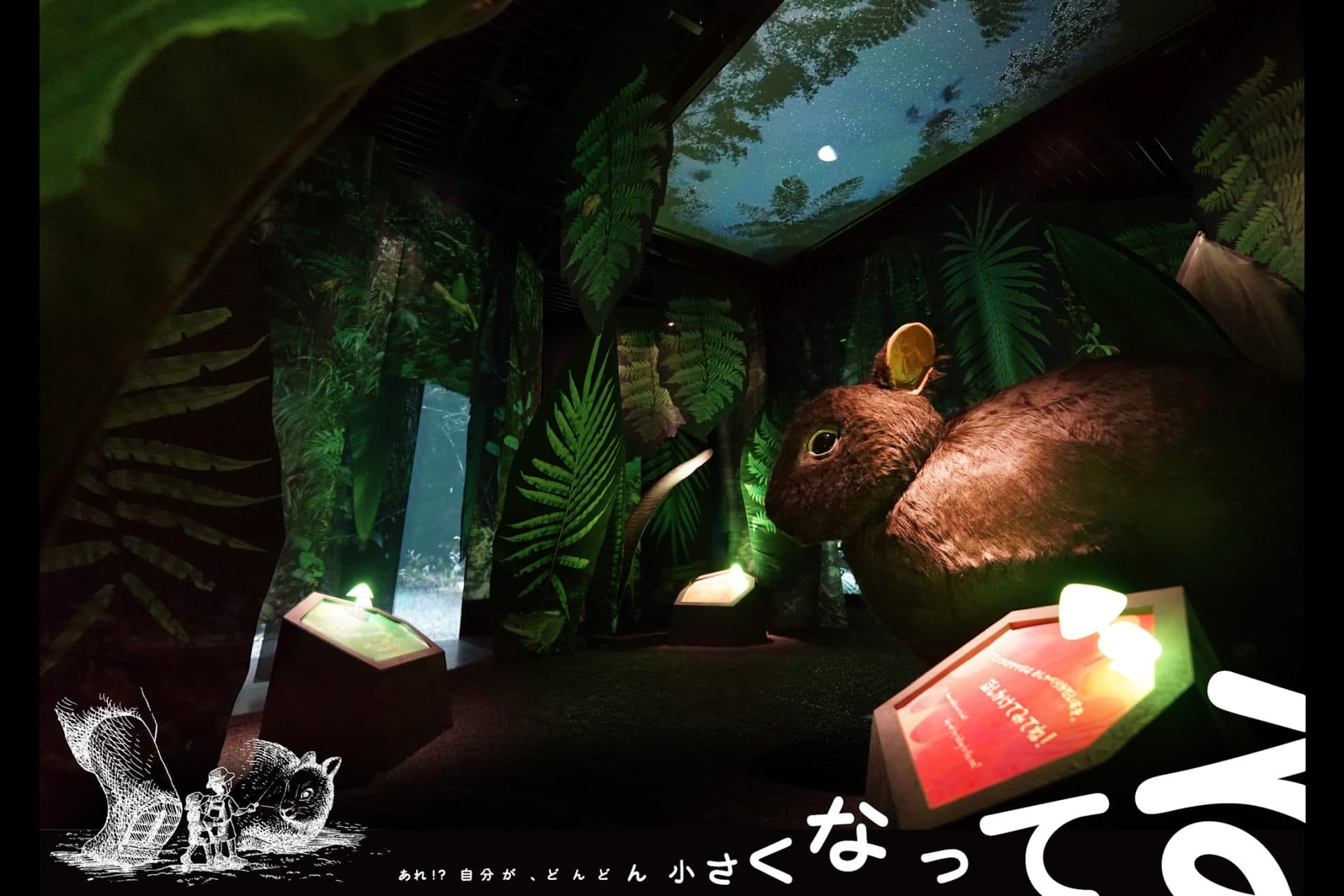
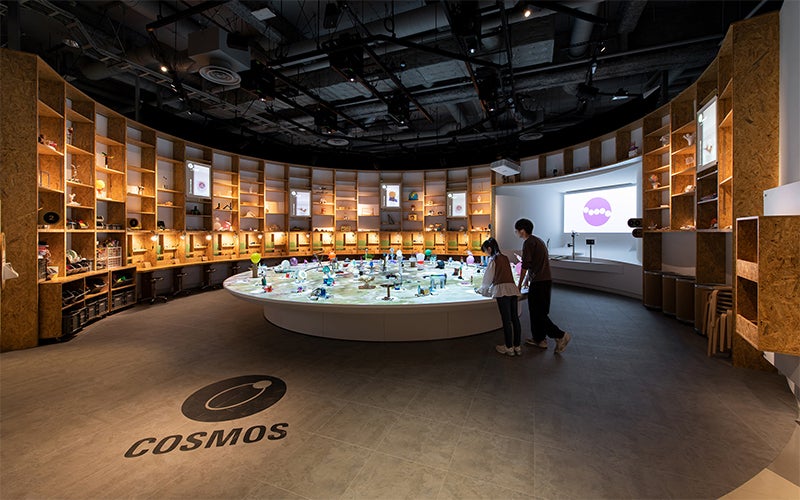
I was in charge of the spatial concept design for an interactive museum aimed at fostering children's curiosity.
▲Panasonic Creative Museum AkeruE
Koga says that while aspiring to be a designer, he didn't have a concrete image of what he wanted to create spaces during his job search. He explains why he decided to join NOMURA Co.,Ltd. after considering various companies.
Koga: "As the largest company in the display industry, I was attracted to the breadth of their concept design scope and the number of projects they handle, not only for office and shop interiors, but also for cultural facilities and large events such as motor shows. The thought that I could have a variety of experiences was the deciding factor in my joining the company."
After joining the company, Koga was assigned to the business division, which handles corporate museums, displays, and sales promotions. For several years, he worked on relatively small-scale projects in displays team, but as he gained more experience, he was entrusted with permanent exhibitions and large-scale displays.
After that, Koga became involved in many projects within the Panasonic Group, gaining experience in various fields, not just displays, but also offices and showrooms. One of the projects he worked on was the "Panasonic Creative Museum AkeruE".
Koga "AkeruE is the successor facility of RiSuPia, a hands-on museum where you can experience the charm of science and mathematics that used to be in the Panasonic Center Tokyo in Ariake. Based on STEAM education (*), the theme is SDGs. It was established as a place to practice inquiry-based learning and to nurture children's intellectual curiosity and inspiration, with the aim of nurturing human resources who can face new social issues.
concept design concept is based on five elements: "a feeling that it's okay to get it dirty, a feeling that you can create it yourself, a feeling that it can be rearranged, a feeling that it's not bound by a framework, and a feeling of collaborative session." We intentionally used the colloquial words that the members spoke during brainstorming sessions at the beginning of the project as the concept.
Koga says that during the concept-making process, he thoroughly discussed how the space should be so as not to put the brakes on the children's imagination. It took shape while involving various members.
Koga: There was an atmosphere of ``Let's try it anyway,'' and members of other companies who were in charge of planning and operation came together to come up with ideas, and we solidified the concept while actually experiencing it ourselves.
In total, more than 100 people are involved, with many artists participating, discussions with researchers about the principles of art, and educators stationed at the studio.”
AkeruE opened in April 2021. It is said that there is a big reaction.
Koga: It's been quite a success, with groups of elementary and junior high school students coming in almost every day. We received an unbelievably large number of entries, and the finished works by the participants are all wonderful.
*STEAM education: An educational method advocated by adding Art to STEM education, which integrates the learning of Science, Technology, Engineering, and Mathematics.
The showroom has been transformed into a community space. Creating a community that can grow with the region
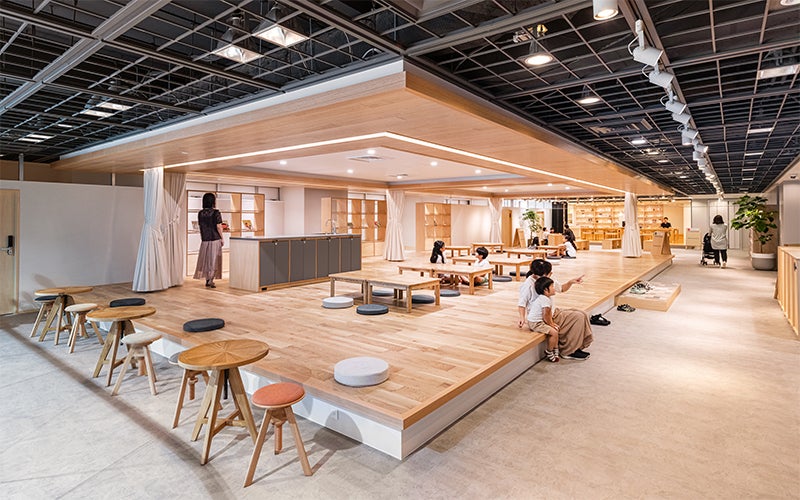
▲ KeiyoGAS Community Terrace
Another thing that Koga has been involved in so far is "KeiyoGAS Community Terrace" that left a particularly strong impression on me. This project refurbished the Keiyo Gas showroom in Ichikawa City, Chiba Prefecture, into a community space open to the local community.
Koga: "The customer had the idea of rebranding to a company that provides comprehensive support for people's lives, so I proposed a move away from the showroom.
It was a rather bold decision for the customer of the gas company not to display products such as gas appliances, but as a result, we created a space that embodies the brand concept of corporate activities aimed at gaining empathy from the local community. I think it did."
Koga worked with the planner to handle the planning and spatial concept design. He says concept design embraces the free activities and diverse ways in which local residents spend their time, creating a space where everyone feels like they belong.
Koga: "concept design concept is 'engawa' (veranda). The name 'KeiyoGAS Community Terrace (commonly known as 'Terasu') reflects our hope that it will become a space that serves as a point of contact between people, the city, and daily life, where people can easily drop by and take a break, just like an 'engawa' or 'terrace'."
Under the slogan, “Light up children, adults, and the town,” we have developed a mechanism that allows users to participate in community building and efforts to support the lives and activities of local residents. We wanted to create a community that would grow.”
Koga says that he created it while thinking about it together with citizens and local groups. Here too, we worked with the planners to pick up the voices of the locals and put them into shape.
Koga: "In preparation for the competition, the planners took the lead in thoroughly researching even the smallest details, such as observing the surrounding facilities and people walking on the streets. We gathered information on issues and problems from citizens and local organizations, such as 'We're having trouble finding a place to go' and 'The number of places for children to play has decreased due to the pandemic,' and then translated that into a concrete concept design."
Koga says that in recent years she has been able to create warmer spaces that place a greater emphasis on comfort. She says that her experience of taking maternity and childcare leave is reflected in concept design.
Koga “I feel that having a child has given me a new sense of sensibility. I keenly felt the need for such a space.
In the KeiyoGAS Community Terrace project, I believe that the new perspectives I gained from spending time with children were successfully incorporated into the spatial concept design, such as concept design a comfortable space where people can relax easily and placing greater emphasis on well-being."
Social good and well-being initiatives through the creation of spaces in life
Koga says that interest in spaces in daily life is growing more and more these days. This is how I see my direction as a spatial designer.
Koga: I would like to create a place that is always there and can be called a place to belong.
For example, there are times when simply being in a space you like can enrich your life. To put it a little dramatically, I hope that the richness brought about by spatial concept design can be enjoyed by everyone as a matter of course, like social infrastructure. I hope to increase opportunities for people to experience such spaces.
Also, in an interview, one of my juniors said, "I want to concept design that I don't feel guilty about," and I completely agree. Lately, I've been incorporating upcycling of existing materials and other elements to the fullest extent, based on the SDGs, into my spatial concept design. I hope that creating spaces in people's lives will naturally lead to social good and well-being initiatives."
Being able to participate in such initiatives is something only NOMURA Co.,Ltd. can offer. Koga continues, regarding the appeal of the workplace:
Koga “This is the best opportunity in the industry to work with various professionals inside and outside the company, such as sales, planners, directors (production management), and people from cooperating companies. As I often advance the development process, I sometimes come up with ideas that I had never thought of during conversations.
Sayaka Koga
Joined NOMURA Co.,Ltd. in 2008. Spatial designer. concept design spaces across various fields, including offices, educational facilities, showrooms, and displays. Recently, mainly responsible for planning and concept design communication spaces. Values concept design "experiences."
The core principle is communication. A socially beneficial space realized through concept design of experiences.
PAGE TOP
Contact us
Please contact us using the button below if you have an inquiry, want to request a quote or request documents. We have created a separate “FAQ page” that lists the most common questions we are asked. Please take a look at this page if you have a question.
This website uses cookies to improve customer convenience and also to maintain and improve the quality of our services. Click the “I Agree” button if you agree to the use of cookies. Refer to the Privacy Policy for details.


![Drawing out children's passions through numerous experiences [Part 1]](/_next/image/?url=https%3A%2F%2Fnomura-kogeisha.g.kuroco-img.app%2Fv%3D1779774440%2Ffiles%2Fuser%2FSCENES%2FVol.05%2FPandD_JUNOPARK%2F477A3016b_jitsuga.jpg%3Fwidth%3D800&w=1920&q=75)