
What kind of school will the future be like, a place where children and local adults can gather after school?
- #social good
- #wellbeing
- #Sustainability

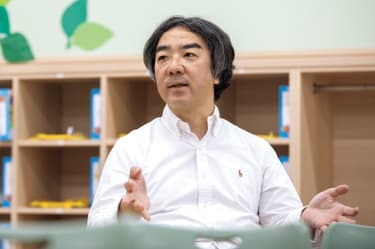
Kuniyasu HiraiwaAfter School NPO After School/Nitobe Culture Academy
Representative Director/Chairman
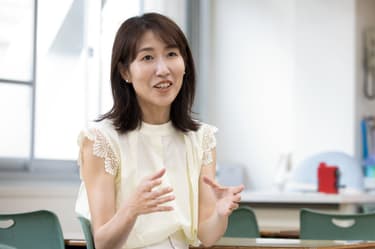
Nakamura TomohanomuraNOMURA Co.,Ltd.
Business Production Division, Third Management Department, Public-Private Partnership Project Development Department, Chief
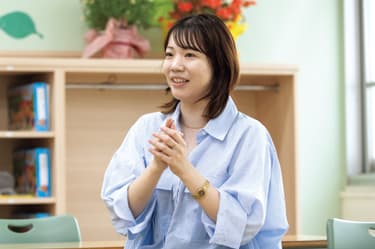
Aoi Okabe,NOMURA Co.,Ltd.
Business Production Division, Third Management Department, Public-Private Partnership Project Development Department
Insights - The Shape of the Future
Kuniyasu Hiraiwa, the founder of the after-school NPO Afterschool, has been working to create safe spaces for children after school. Yuha Nakamura and Aoi Okabe of NOMURA Co.,Ltd., who make solving local social issues one of their jobs, discussed the ingenuity they used in their first joint project and what they learned about the future of safe spaces in society.
Has the kids' after-school routine changed?
Hiraiwa: I came up with the idea for After School NPO in 2004. It was around the time my daughter was born, when child abduction cases were on the rise. When I read articles about these cases, the headlines often said "on the way home from school" or "on the way home from school," and the incidents usually occurred around 3 or 4 PM. I later researched this and found that 70% of crimes involving children occur between 2 PM and 6 PM. So, when I looked into the park on a weekday evening, there were no children in sight. When I was a child, it was normal for everyone to play outside and have fun until 5 PM and then go home together, so I thought, "Huh? Maybe kids' after-school activities have changed!?" This was the direct trigger that led me to focus on "after-school activities."
In America, "after-school" spaces, places for after-school activities, have become part of social infrastructure in many regions. Learning about this, I wondered if they could be useful in Japan as well, and decided to start an initiative. Initially, I planned to have local residents known as "citizen teachers" teach the children something, and I quickly found a Japanese chef to play the role. So, when I approached the school to use the school as a venue, they treated me like a suspicious person and refused to take me seriously. It was difficult to find people willing to participate, but with the cooperation of a local welfare officer, I was able to start with four participants at a community center in Setagaya Ward, Tokyo.
After that, the community center after-school programs got on fairly well, with around 20 to 30 participants regularly gathering at two community centers. However, they still couldn't get into public schools. Then, a staff member at a school after-school program run by Setagaya Ward agreed to include us in the program.
However, the main operator was the local government, so we were looking for a way to open a permanent after-school program within the school as an NPO. At that time, the private Nitobe Bunka Gakuen gave us a chance, and we were able to establish a permanent facility. This was in 2011. It wasn't until 2015 that our achievements were recognized and the doors of a public school finally opened.
It's important that your "everyday space" is filled
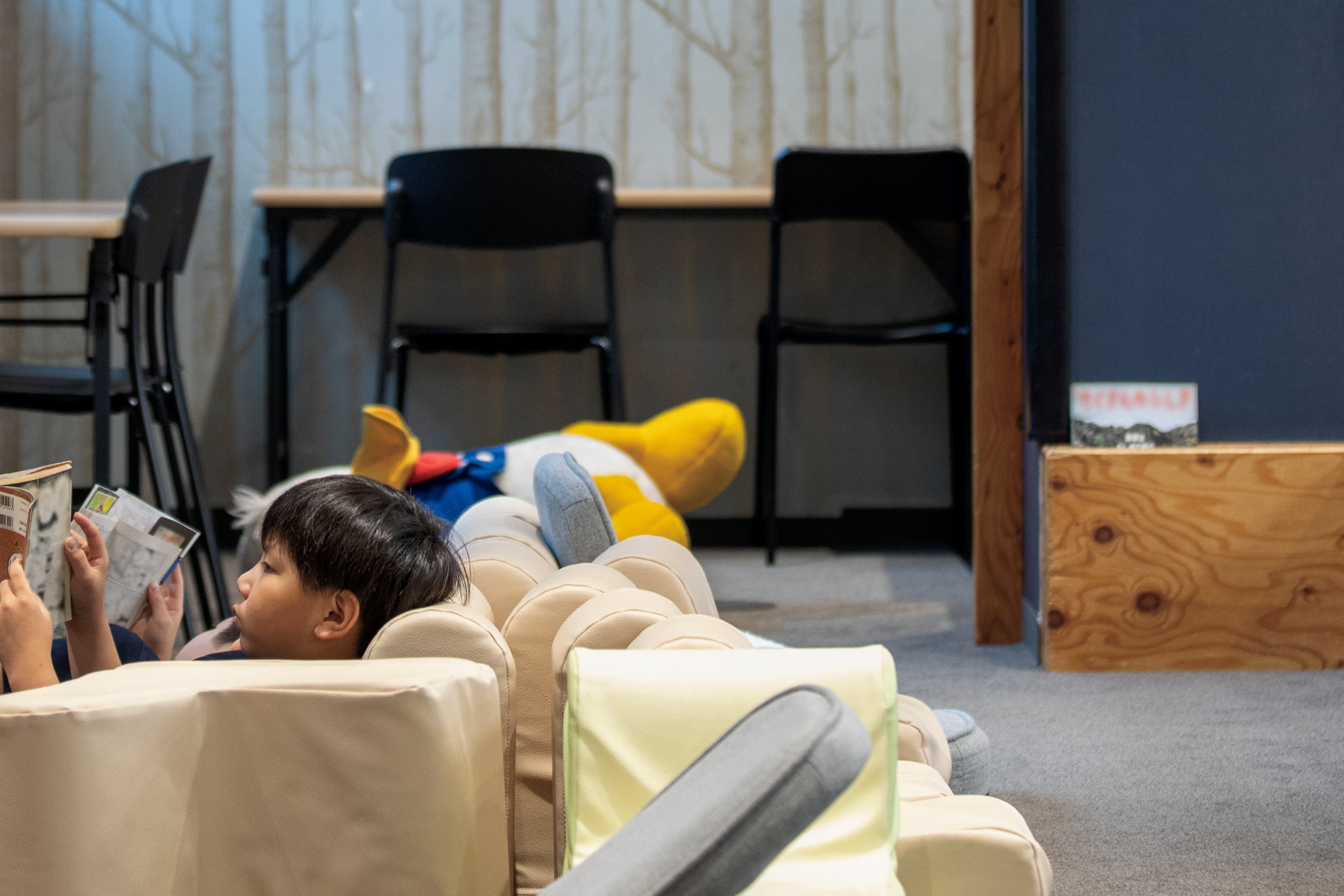
Nakamura The Business Production Division, where I work, is responsible for formulating solutions to various social issues in collaboration with a wide range of people in society. Currently, with the increase in dual-income households and the rise of nuclear families, we feel that there is a shortage of places for children to go after school, and that adults are losing their connections with their communities.
The reason is that the COVID-19 pandemic hit just as I went on maternity leave for my first child. All sorts of outing facilities were closed, I couldn't meet people, and I had to spend all day alone in a space with my child who couldn't even talk yet. NOMURA Co.,Ltd. is a company that provides "Delight and Passion" through the creation of spaces, but I keenly felt that the premise for this is that everyday spaces must be fulfilling. So, after returning to work, while special occasion spaces are certainly important, I started to focus on social issues and spaces that are closely related to daily life.
So, we found [Afterschool NPO], which was thinking along similar lines, and together with Okabe, we contacted them.
Okabe During my long involvement in the management of commercial facilities, I have had many opportunities to hear directly from local residents. Utilizing that experience, I wanted to take on the challenge of utilizing private funding and know-how in the design and management of public facilities as my next step. By focusing on school-centered urban development, we can listen to the voices of local residents and consider ways to create a vibrant community that makes the most of the area's unique characteristics. So, I was interested in what kind of initiatives could be implemented with a focus on schools.
Nakamura As we were listening to various stories from the after-school NPO, they asked us if we would like to join them in Kawasaki City's "Creating a place for children to hang out after school, etc."
I want to make use of every single child's opinion
Hiraiwa: Right now, listening to children's voices is receiving a lot of social attention, and Kawasaki City has been a municipality that values this for a long time. As one of the things they put into practice, they wanted to create an after-school space for children where children's voices would truly be heard. So when they contacted our NPO, we thought it would be great if we could collaborate with NOMURA Co.,Ltd., who are professionals in creating spaces.
We want to leverage the expertise we've gained so far to expand after-school spaces that children will want to visit throughout Japan. In that vision, creating the right space and zoning are extremely important. We need to renovate and utilize spaces that were previously unused to increase the number of places where children can spend time. We have ideas and concepts that we've come up with by listening to children's voices, but we thought it would be wonderful to work together with NOMURA Co.,Ltd., who are professionals in space design, on things like furniture selection and color schemes.
Nakamura: In the project, we wanted to listen to each and every child's opinion without missing a thing and reflect it in the space. We spent the most time figuring out how to structure that process. When we say listening to children's opinions, if you start from scratch and ask elementary school children, "What would you like this place to be like?" or "What do you want to play and do?", they won't be able to imagine it, and many children find it difficult to express what they think exactly. Even if they do speak, it's also important to understand what potential needs lie behind those words.
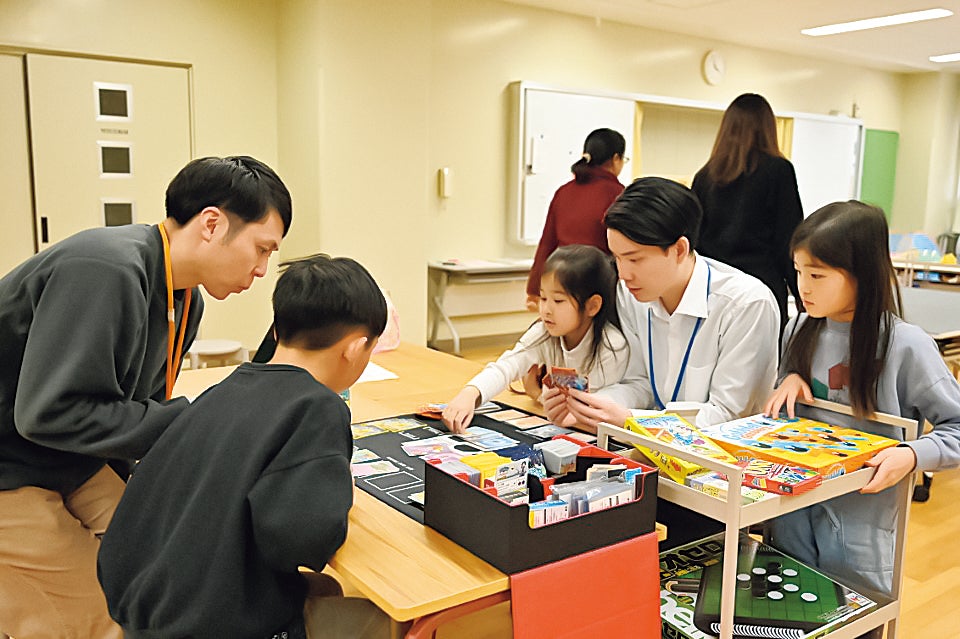
As we continued to hold discussions with the after-school NPOs, one very helpful suggestion came from them: "Why not recreate an after-school playground, even if it's only temporary? Let's have the children play there, and once they have a sense that something like this can be done inside the school after school, let's hear their opinions." So we built a temporary playground.
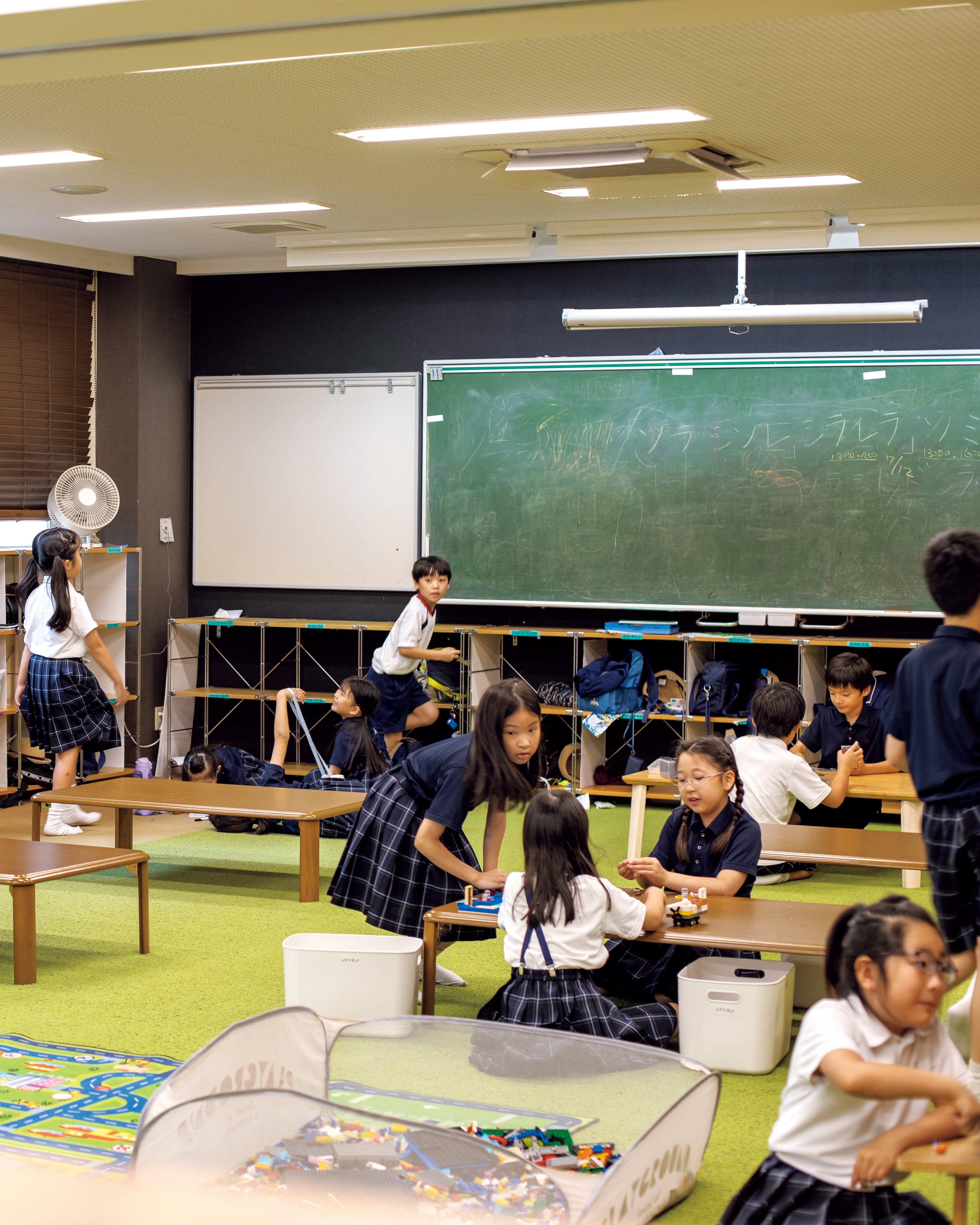
Okabe: We collected a lot of cardboard boxes and created spaces for the children to use as they pleased, for playing card games, playing with stuffed animals, and for crafting. We even brought in tents. Everyone wanted to hide, so maybe it was like a secret base.
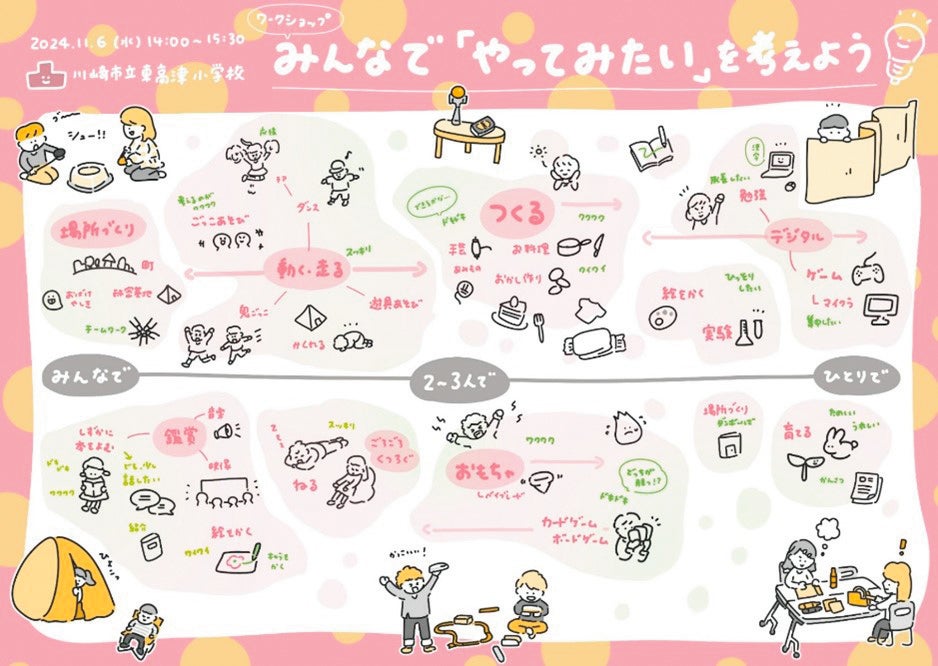
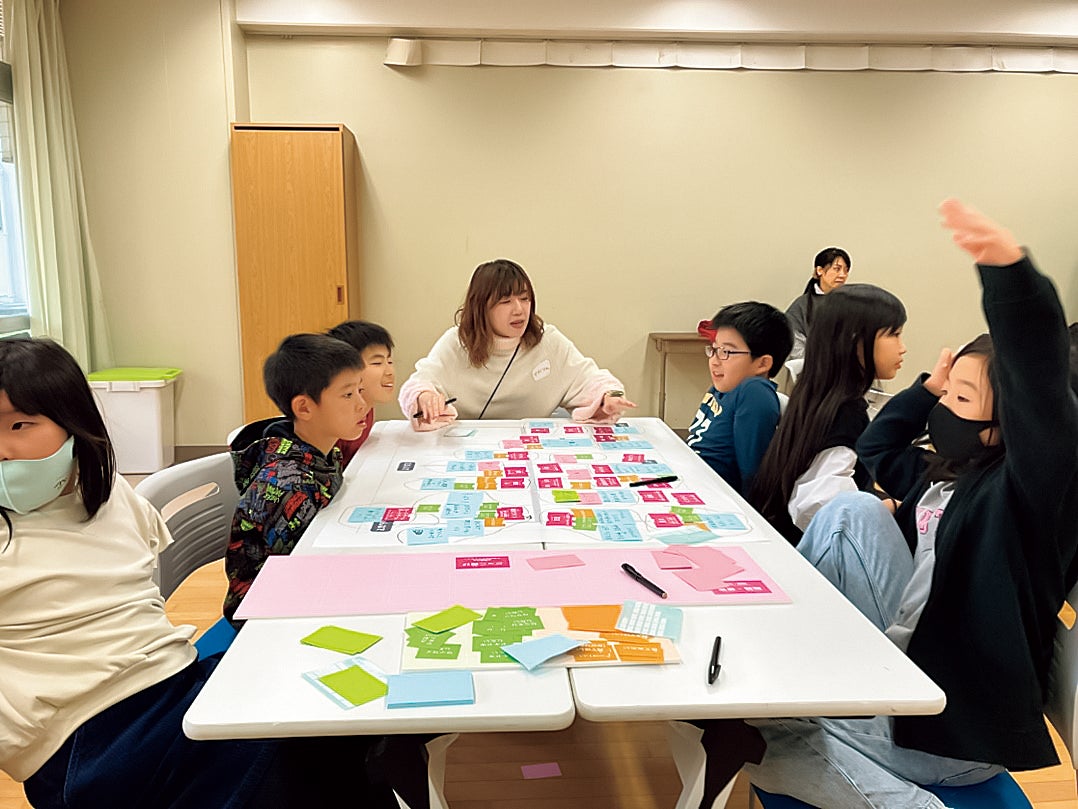
Nakamura: After the temporary play area is over, we change the scene and listen to the children's opinions. Some children can express themselves well in words, while others cannot, so we prepare lots of cards to draw out the children's feelings.
On the cards, people write down things they want to do, such as "I want to read" or "I want to dance." They also write down how they feel when they try it, such as "exciting," "nervous," or "fidgety." We prepare lots of cards with modifiers like these, and ask people whether they want to do it alone, with others, or in groups of two or three. We prepare a large piece of paper, which we call a "scale," and have them place the card where it matches their feelings.
Okabe: We had a graphic recording specialist turn the children's opinions into cute illustrations on the spot. The children were delighted to be able to immediately visualize their opinions, and it really raised the level of detail of what they wanted to do in this space. We put the illustrations up on the wall, and children who couldn't attend on the day could add their opinions on sticky notes. We collected over 60 comments within a week.
There's a difference between "rolling around alone" and "rolling around with everyone"
Nakamura: First, we put all the ideas that came up into a table. We categorized the things we wanted to do, dug deep into the feelings behind them, and linked them together to analyze what spatial elements would make them happen.
Okabe: For example, if there is a need to "laugh out loud," the feeling of warmth will differ depending on whether you want to lounge out alone or lounge around while playing with friends. To incorporate this difference, we asked the creative team to think about how to arrange the lounging space in the space.
Nakamura:What we were careful about during the spatial design phase was not to separate the space based on individual requests, but to allow children to coexist while maintaining a sense of distance so that they would not be disturbed by other children doing different things, by adjusting the height and orientation of the furniture, because it is absolutely necessary to keep an eye on the children and ensure their safety.
Also, since it is not a dedicated space for after-school activities, it needs to be restored to its original state after each use. We have a proper storage plan. It can be removed when not in use, folded up or stacked, and stored in the right place. But when it is time to use it, it can be easily spread out and configured. We call it "variable and movable," and this ingenuity was very important.
In the Kawasaki City project, we also created an after-school space for children in the upper grades of elementary school and above at the Children's Cultural Center, where we used a different approach to listen to the children's opinions.
I went to the opening event for the Hiraiwa Children's Cultural Center, and the children really seemed comfortable there. I heard that it was originally a warehouse and conference room. Everyone cleaned it up, listened to the children's voices, and turned it into a place for children in the upper grades of elementary school and above. They've created zones that cater to the children's needs. I later heard that children who have difficulty attending school were coming to the center, and I really felt that there were more places for them to go. Socially, there is a severe lack of places for children in the upper grades and above, so I was reminded that they have created a great model.
Thinking together about the "classroom of the future"
Nakamura: Last year, we also worked on the Ministry of Economy, Trade and Industry's "Classroom of the Future" demonstration project. With the cooperation of the NPO After School as an advisor, we conducted a multifaceted study, including legal research and interview surveys, to examine how school facilities could be utilized as the core of local public facilities and the possibilities and challenges involved. We also used classrooms at an actual elementary school after school hours to try offering experiential programs for children.
In providing the Okabe Program, we asked local companies and individuals to participate and prepared a variety of events. We received a lot of feedback from parents, such as, "It was great that my child was able to participate in an experience that interested them after school while still at school."
If we could utilize a familiar setting like a school, we felt that it could create a connection between local adults and children, giving children the opportunity to discover the seeds of their interests and allowing adults to make new discoveries, making it a valuable space for both parties.
The possibilities for school space are endless
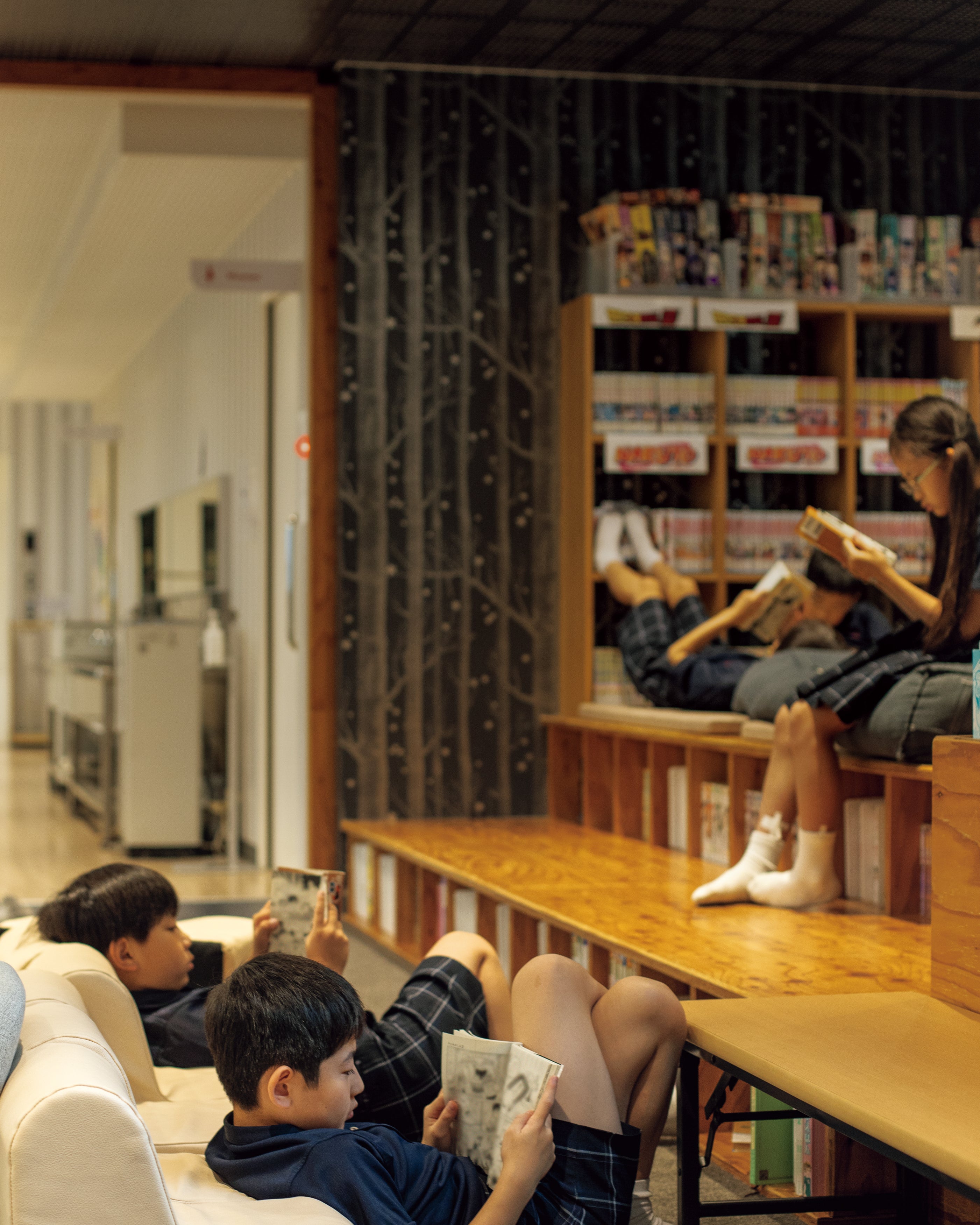
Hiraiwa: I was talking to the head of a local government, and he told me that half of the total floor space of the city's public facilities is schools. He said, "It's a waste that they're not being used," and I really think that's true. They can be used by children after school and by adults in the evenings, and they're open on weekends too. So I want to make better use of them for the benefit of the citizens.
Of course, we must respect the importance of the school and the work that teachers do every day with a sense of responsibility, but we can also use this space for everyone to learn, play, exercise, build a community, and even serve as a disaster prevention base. Schools are truly multifunctional facilities with the potential to do a variety of things. You can play sports, cook, make things, even do science experiments, and they even have Wi-Fi. Some places even have nurses on site. Spaces like this are hard to find. There are limitless things that can be done there.
Nakamura: I agree with what you say. Until now, public facilities such as libraries, community centers, and schools have been built with a single function, but considering the costs of construction and maintenance, I think that going forward, we will see a trend toward consolidating everything into a core facility, with multiple functions, diversifying according to time of day, and using the same space in multiple ways.
When creating a space, we place importance on designing it based on people's activities and experiences. We imagine the users of the space and think about how they will spend their mornings, how they feel when they come to the space, who they will interact with, what kind of conversations will take place there, what they will touch, what they will see, what feelings they will have, and how they will leave at the end. We imagine each of these scenarios. We then assemble the functions and zoning of the space from these specific scenes. We want to create a local place where children can realize their own value, and adults can make new discoveries by interacting with people of other generations, and where such bonds of connection can be formed. To that end, we will continue to place importance on listening to the voices of children and adults alike.
Hiraiwa: I often say that "children should be the subject of all discussion." In traditional school education, we often hear phrases like "make children do something." We make them memorize, study, or go to school. However, I believe that inquiry-based learning, where children decide, choose, and learn for themselves, is still important.
My work field is currently expanding to include after-school NPOs, school corporations, and boards of education, but what they all have in common is that adults should not prepare too much in advance, but should instead "listen to the children's voices and create things together."
(Recorded in June 2025)
Photo by Abe Ryo
profile
Kuniyasu HiraiwaAfter School NPO After School/Nitobe Culture Academy
Representative Director/Chairman
Nakamura TomohanomuraNOMURA Co.,Ltd.
Business Production Division, Third Management Department, Public-Private Partnership Project Development Department, Chief
Aoi Okabe,NOMURA Co.,Ltd.
Business Production Division, Third Management Department, Public-Private Partnership Project Development Department
NOMURA's Media

- NOMURA Co.,Ltd.SCENES


![Drawing out children's passions through numerous experiences [Part 1]](/_next/image/?url=https%3A%2F%2Fnomura-kogeisha.g.kuroco-img.app%2Fv%3D1779774440%2Ffiles%2Fuser%2FSCENES%2FVol.05%2FPandD_JUNOPARK%2F477A3016b_jitsuga.jpg%3Fwidth%3D800&w=1920&q=75)


Please contact us using the button below if you have an inquiry, want to request a quote or request documents.
We have created a separate “FAQ page” that lists the most common questions we are asked.
Please take a look at this page if you have a question.