
Discover and experience the forest of life [tropical rainforest]. A catalyst for people to think about the global environment [Part 2]
- #Kanto
- #Award Winning
- #Renewal/Renovation
![Discover and experience the forest of life [tropical rainforest]. A catalyst for people to think about the global environment [Part 2]](/_next/image/?url=https%3A%2F%2Fnomura-kogeisha.g.kuroco-img.app%2Fv%3D1770275542%2Ffiles%2Fuser%2FSCENES%2FVol.04%2FPandD_Chiba_ZoologicalMuseum%2F0N9A0806_jituga.jpg%3Fwidth%3D1280&w=1600&q=75)

Yoshiaki KiyotaChiba Zoological Park
Coordinator
Suzuko OkanoChiba Zoological Park
Breeding Group 2
Mitsuru MoriguchiOkinawa University, Faculty of Humanities, Department of Child Culture
professor

Yuri Nakagawa,NOMURA Co.,Ltd.
Creative Division, Second concept design Center concept design Department 3, Fukano Room, Designer

Toko Takeuchi,NOMURA Co.,Ltd.
Creative Division, Planning & Production Center, Planning Department 2, Room 5, Planner
Yoshiyuki Ando,NOMURA Co.,Ltd.
Content Integration Center, Technical Direction Department 1, Room 1, Technical Director
I'm not holding back anymore
Another major factor that raised the bar for the discussion was the level of displays and how they were presented. Takeuchi explains:
"The zoo's mission was to make sure displays weren't geared towards children. If young children don't understand, their parents can explain it. There's no idea to simplify things or cut things out just because children won't understand. The idea is to create displays that are 'no holding back at all.'"
Regarding this, Kiyota says:
"Our initial request was, 'Please don't lower the level to a child's perspective.' As you can see from the completed facility, it's not geared towards children. This is because, when environmental issues are presented in a child-friendly way, the content becomes very superficial and shallow. Therefore, even if it's difficult, we want to convey the important points properly."
So, does that mean we're ignoring the children? Not at all. It's up to the teachers and parents to explain the meaning of displays. Our aim is to help adults teach children about environmental issues. That's the concept behind displays. Children can quickly see through gimmicks. Rather than them thinking, when they become adults, that it was a superficial displays that just fooled them, we want to create exhibits that will displays their understanding several levels, making them think, "I didn't understand it when I was a child, but this is what it was all about."
Okano also went around thoroughly preaching this way of thinking.
"Throughout the project, I repeatedly explained to those involved that it wasn't 'from children to adults,' but 'from adults to children.'"
Moriguchi, the supervisor who has extensive experience teaching children, agreed with this idea.
"Children are fascinated by the real thing. They can tell whether something is real or not, even if they don't understand the details. At nature observation events, there are children who follow the professor around without really understanding what he's talking about. I think that's what it's like."
Showing authentic items for adults - this policy makes the hurdles for creating displays much higher.
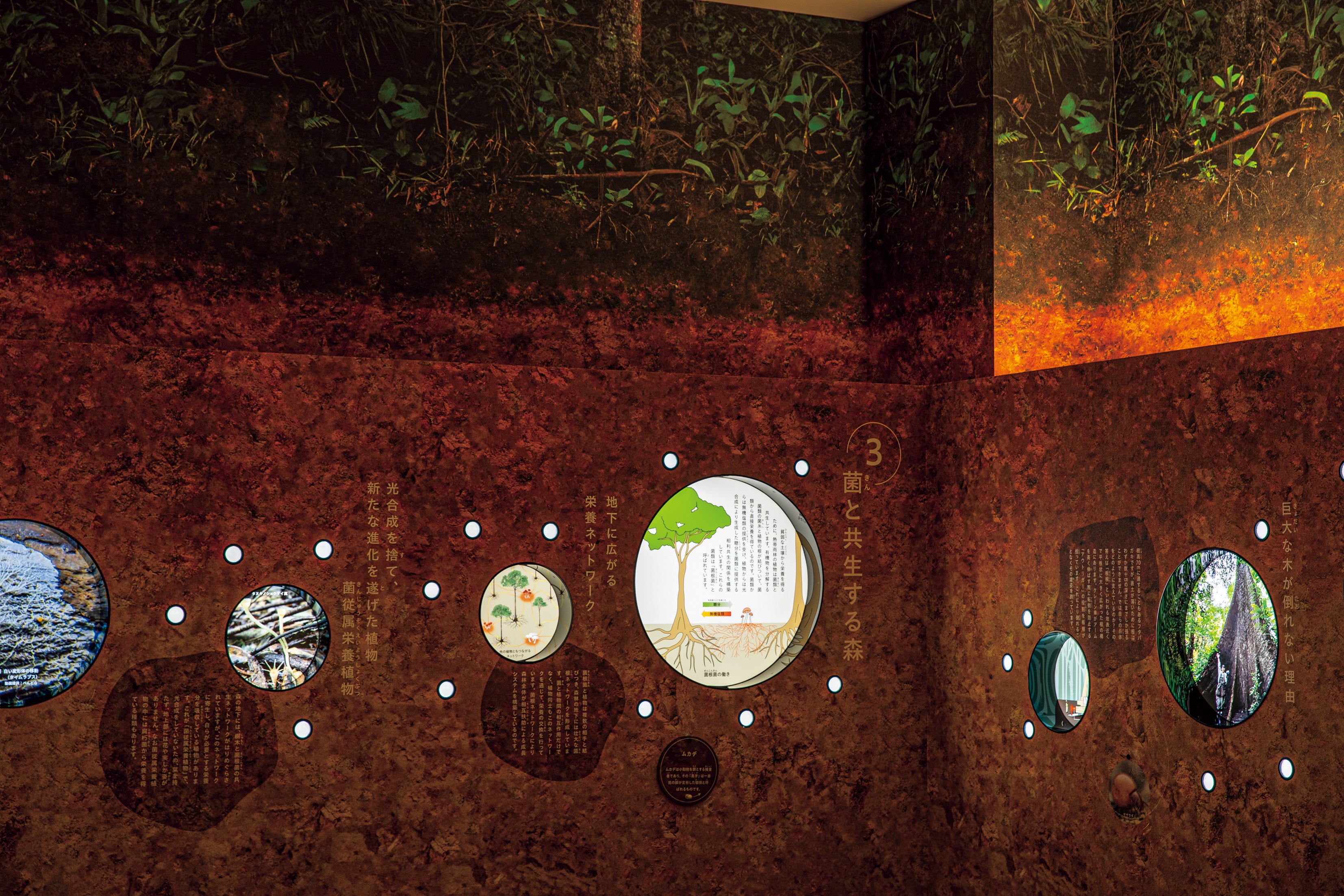
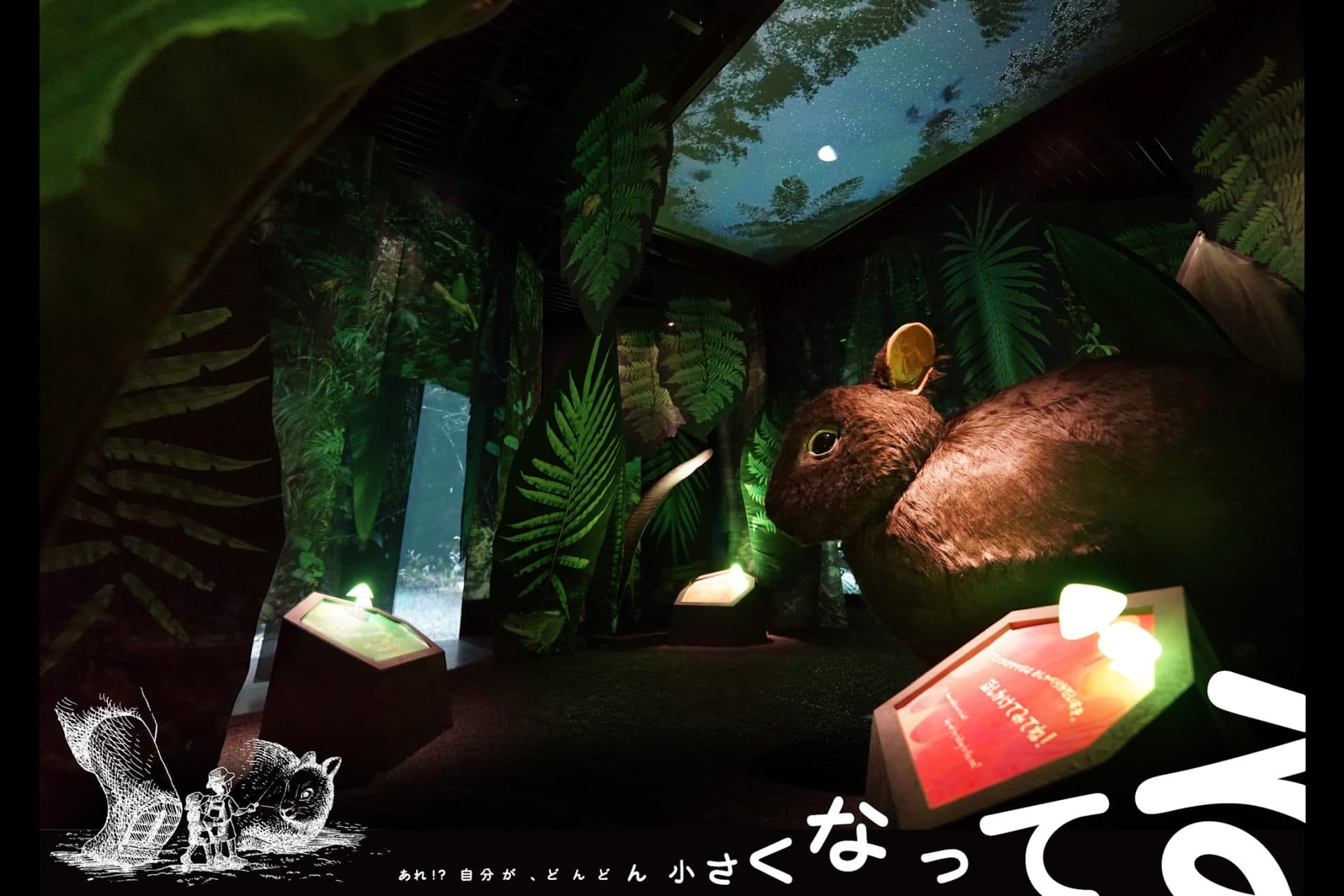
Take, for example, displays Room 5, "The World of the Forest Floor." At the lowest level of the rainforest, in the dim light where sunlight does not reach, tiny organisms squirm about, decomposing fallen leaves and dead wood and providing nutrients to the soil through various functions. This room shows the mechanisms of the forest floor. The main creatures are cockroaches, slugs, millipedes, termites, earthworms and other insects. Although the species are different from those found in Japan, they are just as grotesque in appearance.
"The materials we receive from the zoo are incredible. There are tons of different insects in the photos, and the video producers were screaming," (Nakagawa).
"When it comes to displays that are so disgusting they make you go 'Wow,' Mr. Kiyota and his team are like, 'Of course, that's fine, let's go with it.' They don't mind giving people that much of a shock, and they say it would be great if that momentary shock could serve as a trigger or something that catches people's attention," (Takeuchi).
To bring those ideas to life in a realistic displays, the supervising professors were relied upon.
"The questions were very detailed, like, 'What color is the belly of a cockroach that lives in the rainforest?' Or, 'Are there any earthworms in the tropics?' Professor Yumoto and I answered what we knew, and for the things we didn't know we looked up reference materials. But when you see the finished video, it's worth all the attention to detail," says Moriguchi.
Would you like to go to Borneo to get a mold?
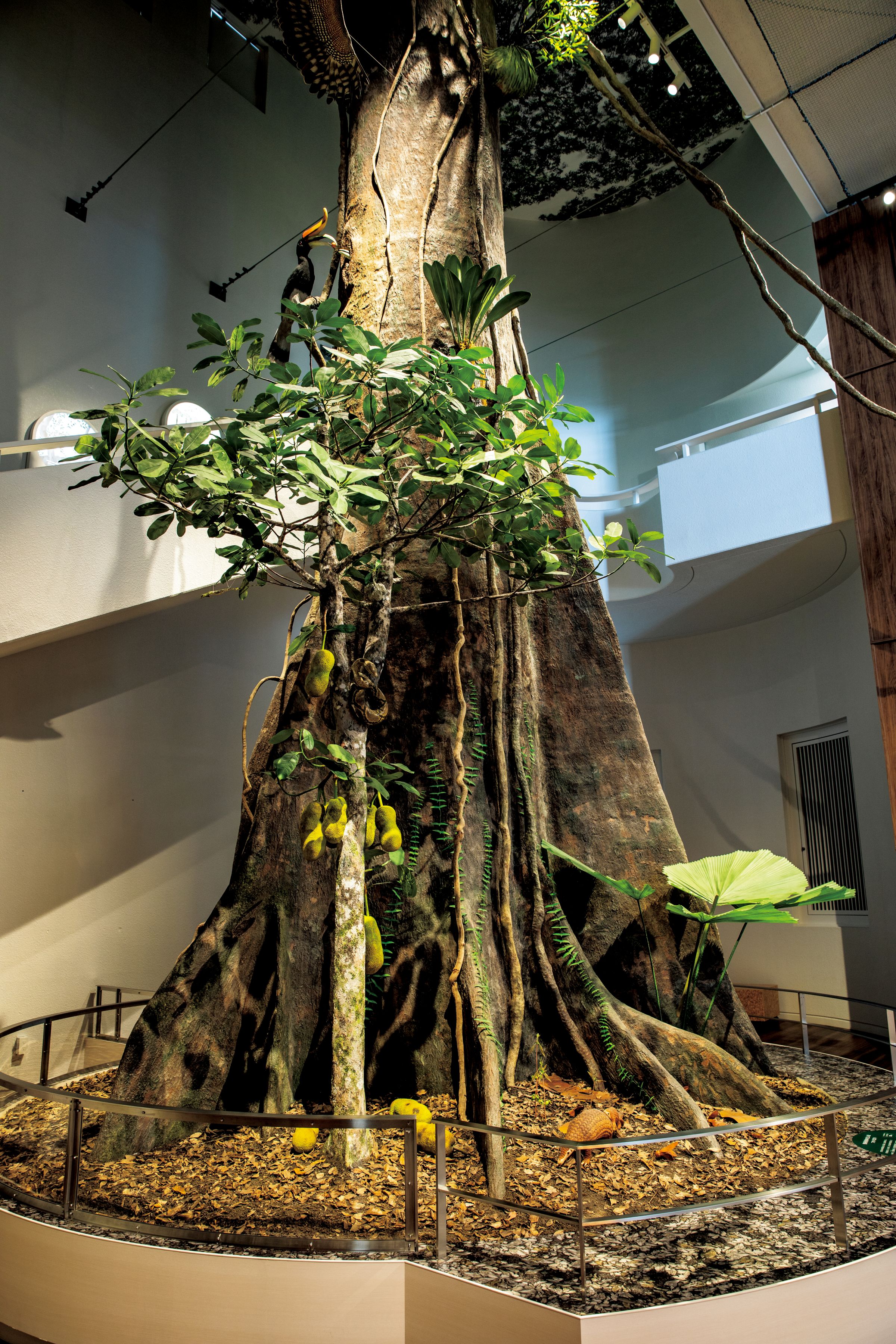
And the element that received the most attention for its realistic detail was the dipterocarp tree, the symbolic tree at the entrance. In tropical rainforests, it's not uncommon to find giant trees exceeding 70 meters in height.
Yoshiyuki Ando, the technical director at NOMURA Co.,Ltd., struggled to figure out how to realistically reproduce this.
"For example, a craftsman could recreate the shape of the bark's surface, but that would inevitably end up looking artificial. Tree roots that protrude from the ground in a plate-like shape are called buttress roots, but it's difficult to know the exact shape of the buttress roots of dipterocarp trees.
Since I didn't know the answer, I suggested that we go to Malaysia to investigate, and they agreed, so we went to Borneo to conduct on-site research."
Accompanying us were supervisors Yumoto, Okano, and Nakagawa, who are familiar with local conditions.
"Even within the category of Dipterocarpus, there are about 200 different species. We also have other trees to displays, so Professor Yumoto's network helps us find suitable trees for molding beforehand, and we ask the coordinator to obtain permission from the local government. They have a very solid system in place for nature conservation."
"Once we get permission, we apply silicone resin to the surface of the tree, its buttress roots, or branches and leaves to create a mold. We can't use very large pieces of silicone resin because we have to transport them back by plane, but for some tree species, we've made molds of entire trees," says Ando.
In addition to taking molds of the trees, Nakagawa also walked through the forest collecting sounds.
"Professor Yumoto showed me to places where he said, 'If it's this time of day, you can hear the sound of that creature!' and I recorded them myself. Different creatures are active at different times, so the sounds I was able to record changed considerably depending on the time of day.
So I had them take me to a variety of different places, including early morning, midday, evening, night, and late night. At the Zoological Science Museum, you can experience the rainforest 24 hours a day, and these sounds are played throughout the museum."
When placing the trees created from molds at the entrance, the supervising teachers' knowledge was utilized to ensure the greatest possible realism.
"At first, we had planned to add dipterocarp leaves, but Professor Yumoto pointed out that the leaves wouldn't grow at such a low position, so we decided to represent them with photographs on the ceiling. The birds are also supposed to be higher up, but we prioritized making them easier to see," says Okano.
"We received advice on arranging the trees, such as making sure that small trees do not grow near the dipterocarps, and on the placement of the surrounding animals. Thanks to this, we were able to create a structure that concentrates biodiversity, despite the space constraints," says Nakagawa.
Finally, playful devices were added, such as placing camouflaged insects on tree trunks, so that visitors would be delighted to come across them by chance.
Connecting everything together like a picture book
The completed Dipterocarpus tree is both a symbol of the Animal Science Museum and a starting point connecting displays within the museum. Nakagawa, who created the original visual that inspired it, says:
"We wanted to connect the entire building, starting from the symbolic tree. displays rooms were divided between the first and second floors, but you start from the base of the symbolic tree, tour displays on the first floor, and when you leave the [World of the Forest Floor], you return to the base of the tree again."
Next, as you ascend the stairs, as if climbing the symbolic tree, the "world of the forest canopy" appears, leading into a story about plants coexisting with animals. The idea was to connect everything like a picture book, while making use of the building's structure."
It was also the zoo's wish to use the symbol tree as the starting point.
"I had hoped that the symbolic tree would be the starting point for an eco-tour around the museum. That's what I had conveyed, and I feel like my wish was realized," said Okano.
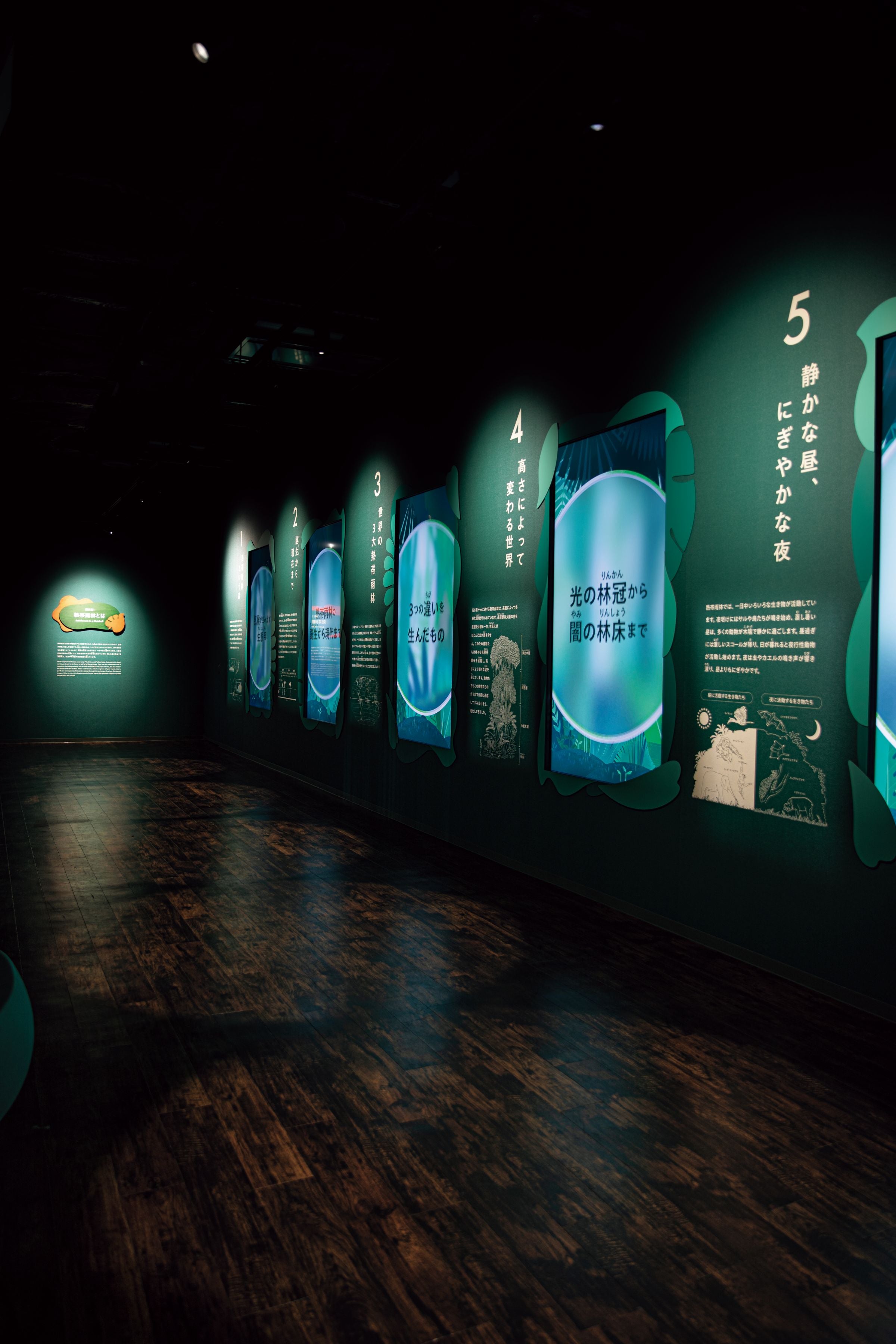
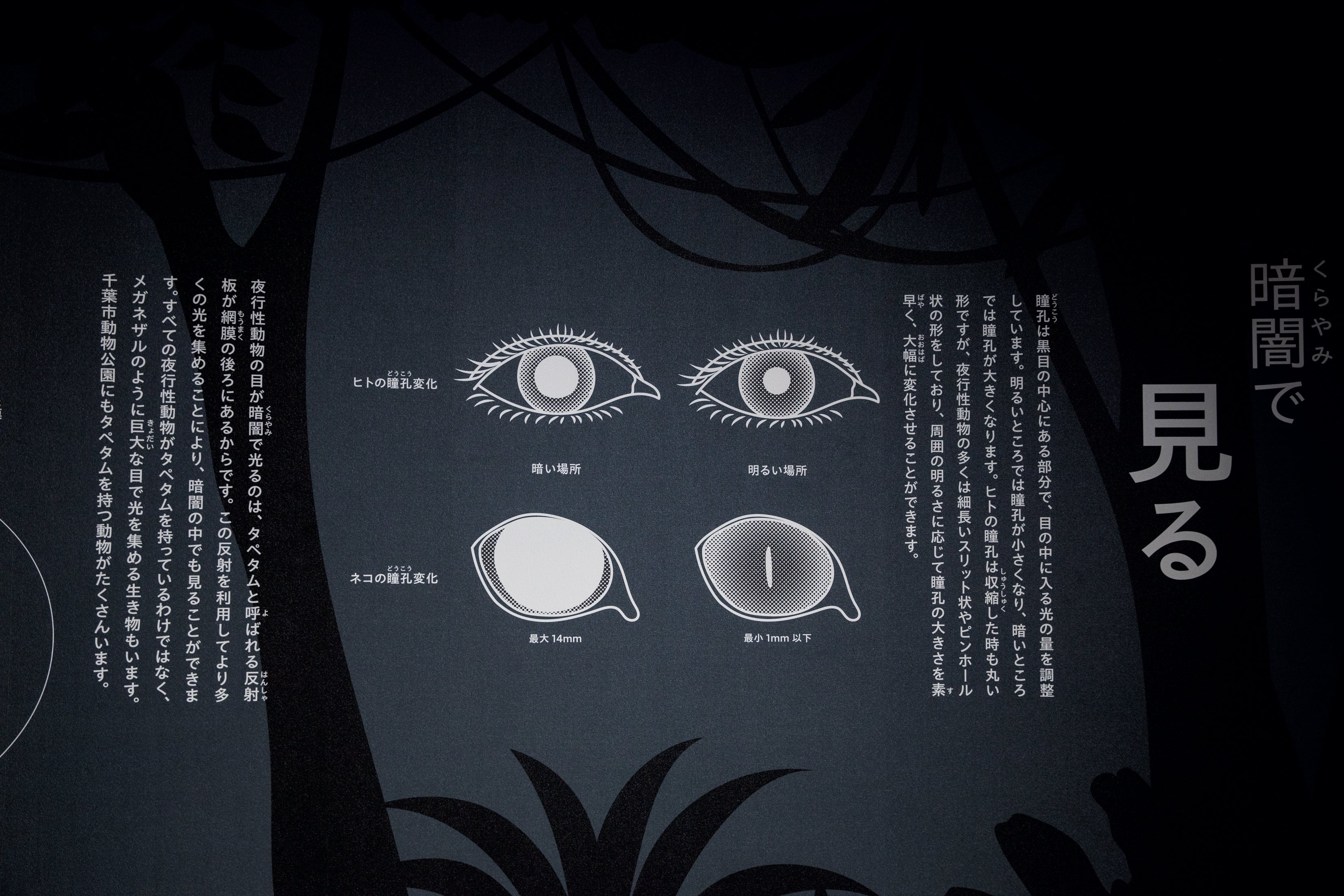
In fact, each displays room in the museum is coordinated with a uniform color scheme and lighting, allowing visitors to experience the rainforest through their five senses as if they were on an eco-tour while walking through the dimly lit rainforest. Large, catchy slogans are written all over the walls, with fairly specialized explanations posted next to them. There's so much information that it's impossible to read it all in one day.
(1).jpg)
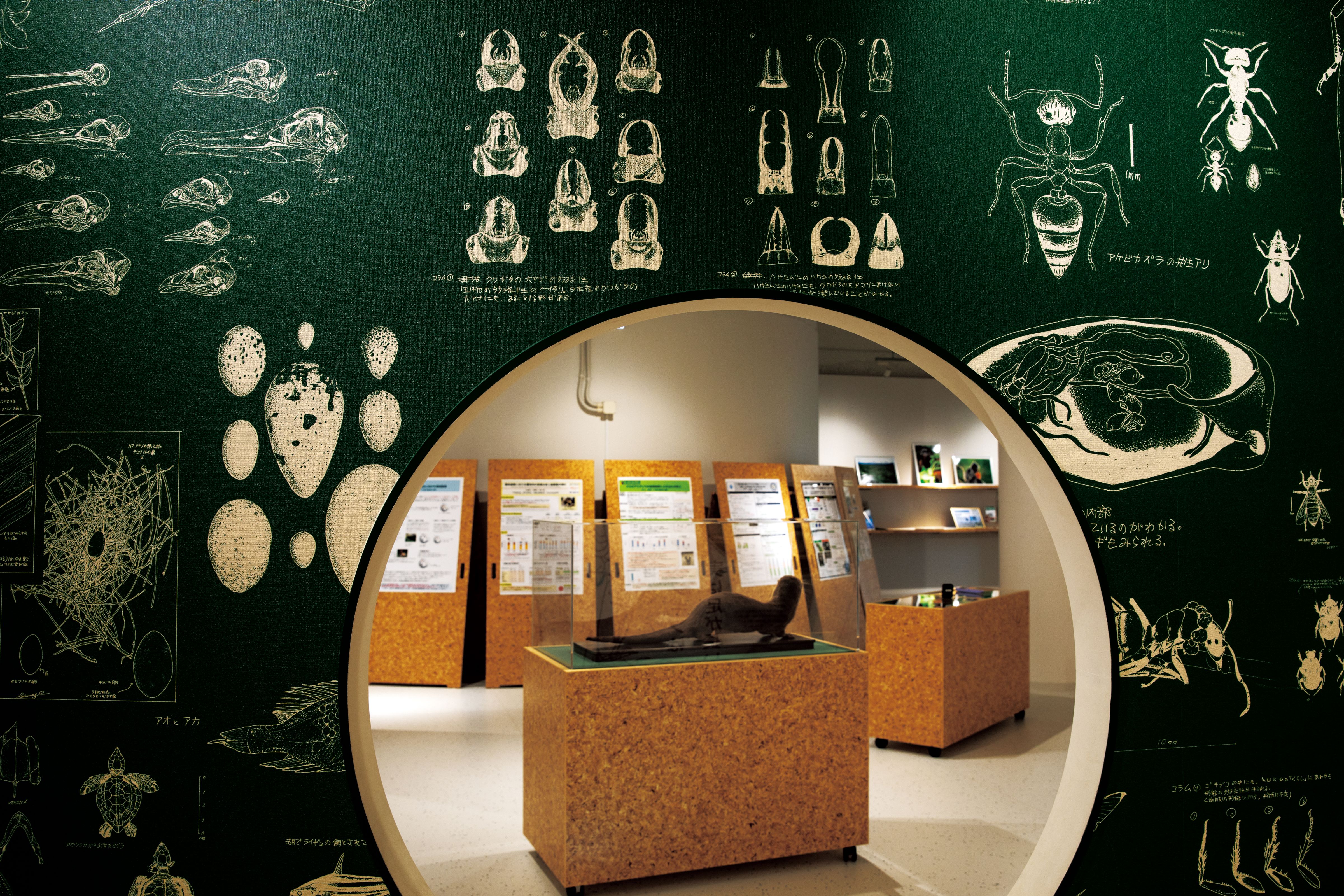
On the walls of the log room, field notes that Moriguchi had accumulated over many years were posted along with hand-drawn observation sketches, symbolizing the world of a researcher. When Moriguchi saw the completed interior of the facility, he had three thoughts.
"One thing is that they're good at using visuals. You have to make it easy to understand so that it gets across, but if you exaggerate too much, you miss the essence. They strike the right balance."
Secondly, it's significantly more stylish than before the renovation. I think it could appeal to people who weren't particularly interested in rainforests before.
And finally, there's the thrill of exploring a dungeon (underground labyrinth). You don't know where you're being led. As you wander through the museum, you get the illusion that you've stayed longer than you actually were. I think it has the effect of allowing various people to remember the cutting-edge displays that resonate with them and take something away with them as a starting point."
Since its reopening, the museum has received positive feedback from visitors.
"Looking at the surveys and comments on social media, we've received more positive feedback than we expected, with people saying they couldn't see everything and want to come back, or that it was very worthwhile and educational."
Shortly after we opened, a family with elementary school children came in and tried to take a commemorative photo after seeing the room titled "[What Humans Have Done to the Forest]". When they pointed their smartphone at the children and said, "Come on, smile," the children replied, "How can we smile after seeing displays like this?" So, it really resonates with children.
"Some children stare intently at the video, while a four-year-old child goes around the seed sample four times. It made me realize that even if you make something for adults, children will still be interested in something genuine," says Okano.
Kiyota, who was in charge of the project, was surprised that the concept they had been aiming for was reflected, albeit unintentionally, even in the lighting of displays.
"Even when looking at the drawings, it's hard to really know what the actual presentation will be like. Now that it's finished, I'm reminded of how amazing displays can be."
In choosing tropical rainforests as our theme for this exhibition, we aimed to clearly show both the positive and negative aspects of the relationship between tropical rainforests and humans. Therefore, while there are dark themes, such as in displays room titled "What Humans Have Done to Forests," there is also the history of humans supporting and enriching their lives by consuming tropical rainforests.
I wanted to avoid creating displays that simply stated that consuming rainforests is wrong, because I felt that humanity had made a mistake somewhere along the way in its relationship with them. Looking around the completed museum with that in mind, I see how the lighting is used to create a dynamic interplay of light and shadow. I think it's amazing."
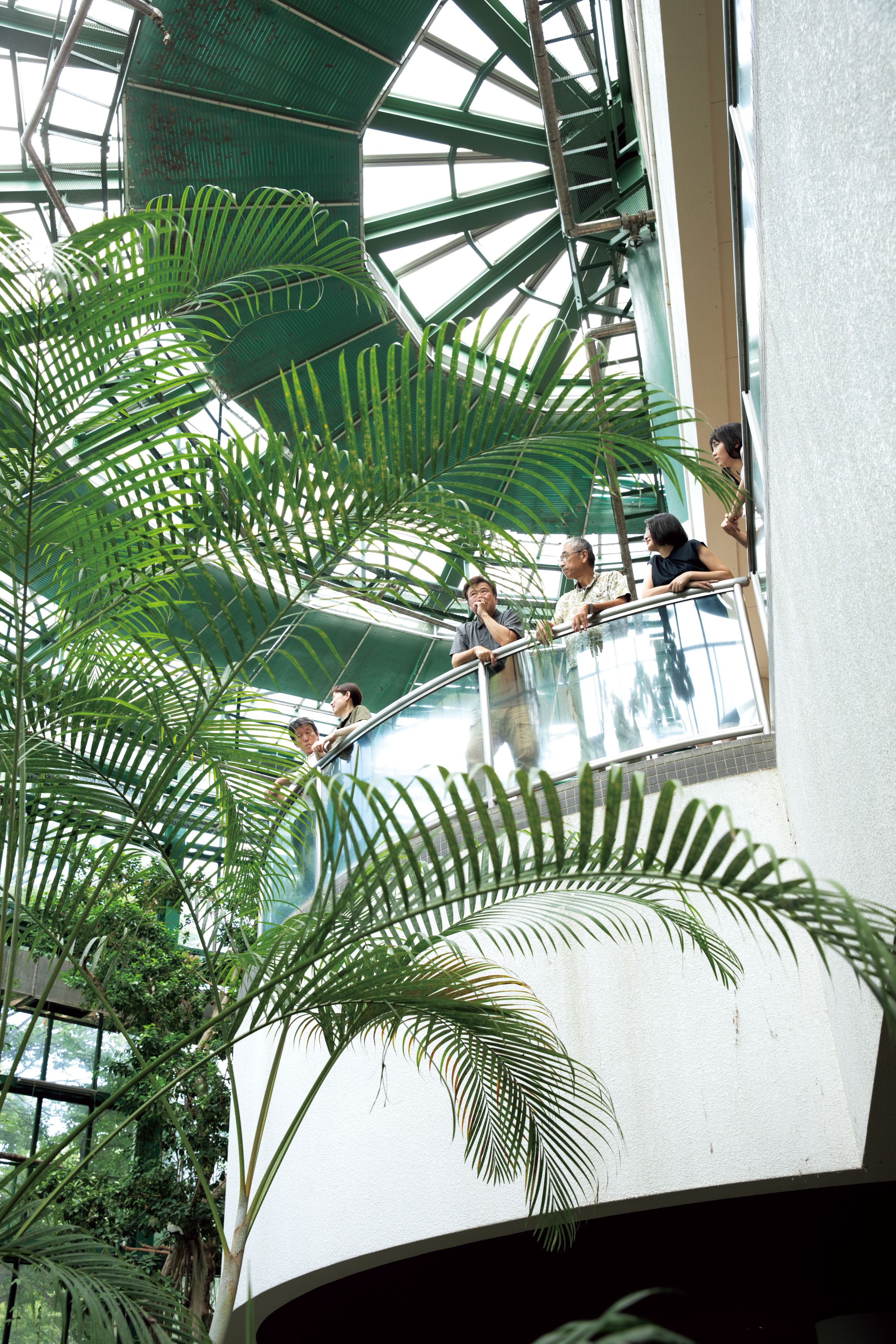
(Interviewed in June 2025. Titles in the article are those at the time of the interview.)
Interview and text by Tsuyoshi Nose (former editor-in-chief of Nikkei Trendy)
Photo by Abe Ryo
profile
Yoshiaki KiyotaChiba Zoological Park
Coordinator
Suzuko OkanoChiba Zoological Park
Breeding Group 2
Mitsuru MoriguchiOkinawa University, Faculty of Humanities, Department of Child Culture
professor
Yuri Nakagawa,NOMURA Co.,Ltd.
Creative Division, Second concept design Center concept design Department 3, Fukano Room, Designer
Toko Takeuchi,NOMURA Co.,Ltd.
Creative Division, Planning & Production Center, Planning Department 2, Room 5, Planner
Yoshiyuki Ando,NOMURA Co.,Ltd.
Content Integration Center, Technical Direction Department 1, Room 1, Technical Director
NOMURA's Media

- NOMURA Co.,Ltd.SCENES


![Drawing out children's passions through numerous experiences [Part 1]](/_next/image/?url=https%3A%2F%2Fnomura-kogeisha.g.kuroco-img.app%2Fv%3D1779774440%2Ffiles%2Fuser%2FSCENES%2FVol.05%2FPandD_JUNOPARK%2F477A3016b_jitsuga.jpg%3Fwidth%3D800&w=1920&q=75)


Please contact us using the button below if you have an inquiry, want to request a quote or request documents.
We have created a separate “FAQ page” that lists the most common questions we are asked.
Please take a look at this page if you have a question.