
Why do people experience joy and emotion? — Unraveling the tacit knowledge of spatial concept design scientifically —

Akihiko TokajiToyo University
Professor, Department of Social Psychology, Faculty of Sociology
Midori SugayaShibaura Institute of Technology
Professor, Faculty of Engineering
Keita Aono,NOMURA Co.,Ltd.
Leader of the "Studies Delight and Passion" Project Team
Insights - The Shape of the Future
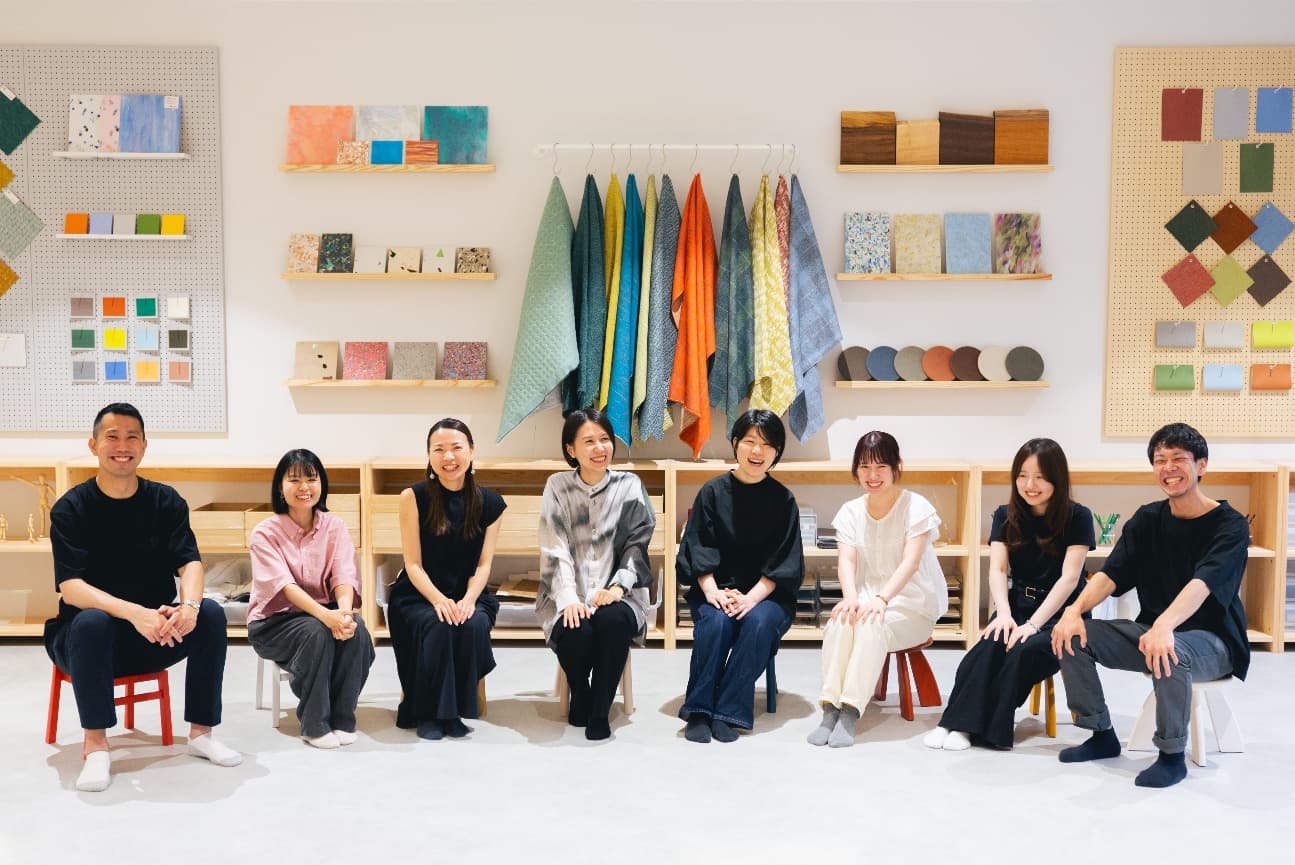
Delivering "Delight and Passion" to people through space creation—this mission, which has been passed down at NOMURA Co.,Ltd. for over 130 years since its founding, has been reflected in actual manufacturing through the experiential and tacit knowledge of its employees. However, now, an in-house research project has begun to verbalize and systematize that experiential and tacit knowledge and scientifically unravel the meaning of "Delight and Passion." We spoke with Professor Akihiko Tokaji of Toyo University and Professor Midori Sugaya of Shibaura Institute of Technology, who participated in the joint research, and Keita Aono, the project leader, about the research results at this stage.
Even if I understand it intuitively, I can't explain it in words.
Aono At NOMURA Co.,Ltd. Ltd., our mission is to deliver "Delight and Passion" to people through space creation, and we have been putting this into practice for over 130 years since our founding. That's why the words "Delight and Passion Delight and Passion are something that all of us employees hold in our hearts. However, it's difficult to clearly explain what "joy and inspiration" actually means. Even though we create displays and spaces that evoke "Delight and Passion" on a daily basis, it's difficult to theoretically explain why we use a particular color or shape. We have accumulated a wealth of experiential and tacit knowledge within the company, but it hasn't been properly articulated or systematized.
Therefore, the "Delight and Passion Studies" project aims to spend the next 100 years conducting research and experiments to systematize "Delight and Passion" so that we can explain them to society.
Initially, we solicited ideas through an internal "social good" initiative, and after gathering around 50 proposals, we divided them into five main research teams, and the project began.
First, we had numerous discussions within the company. We debated what exactly constitutes an emotional impact in a space, and how we could extract that impact. As a result, we came up with the idea of conducting a survey on emotionally impactful experiences.
When we conducted a survey, we noticed that there seemed to be some kind of pattern. But we kept discussing whether our method of classifying and extracting these patterns was correct, as something felt off. Through these discussions, we were able to meet Professor Tokaji of Toyo University, who studies "emotion," and we invited him to join our "emotion profiling" research team at an academic conference. This team aims to create an "emotion dictionary" by verbalizing and systematizing the process of when people feel joy and emotion.
"A feeling of deep emotion" and "I did it!" are two different kinds of emotions.
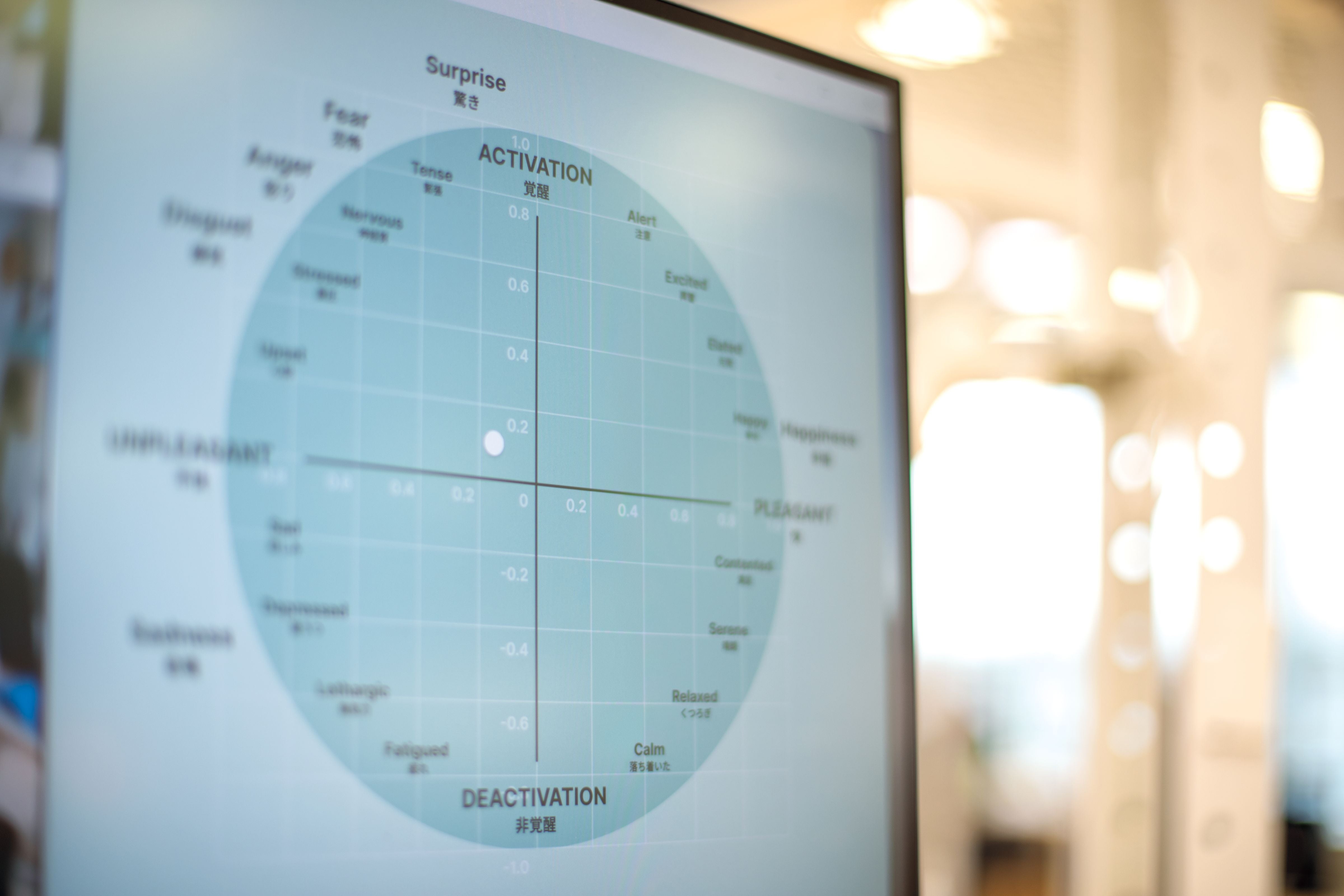
Tokaji: I've been researching "emotions" for a long time, but traditional research on emotions has mostly focused on milder emotions like "mood" or "feeling." So, I wanted to research stronger emotions, and when I looked into "emotional impact," I found that it's hardly been researched at all. There isn't even a word in English to express "emotional impact." So, I've continued my research on emotional impact, including conducting experiments.
For example, let's say we show subjects an emotionally moving video. Even with the exact same video, changing the underlying scenario will result in different emotional responses from the subjects. The impression changes depending on the framework set in the video and the burdens the subjects carry in their lives.
Psychology is a discipline that breaks down phenomena to find their underlying causes, removing noise during the decomposition process. But when you put together the essence obtained from that process, can the emotion be reproduced? Can you evoke the same emotion by refining the impression? Are we removing important elements as noise? I had these questions. Working with creators like NOMURA Co.,Ltd., Ltd. is a form of verification that goes in the opposite direction of academia, so it was a good opportunity for me.
When we actually started working together on the research, I realized that the meaning of "emotion" that I had been thinking about and the meaning of "emotion" that NOMURA Co.,Ltd. had been thinking about were slightly different. I had been researching the strong emotion of what is commonly called "being moved," but NOMURA Co.,Ltd. Ltd. considers all kinds of emotional responses and anything that moves the heart as "emotion." It's a broad definition. Just as there is a difference between the feeling of being deeply moved and the feeling of accomplishment, there are different types of emotion. So, we decided to take a broad view of emotion, and we interviewed various people about their experiences of being moved, and then worked on verbalizing and categorizing those experiences.
The "decision-making process" has become visible.
As the first stage, Tokaji has compiled 10 major categories and 16 minor categories into the "Dictionary of Feelings." This is still in the research and analysis stage, so I believe that as we accumulate more data and conduct more experiments, the Dictionary of Feelings will become even more comprehensive. The Dictionary of Feelings is basically conceived as a form of knowledge management, verbalizing the basics and providing a foundation that shows how certain feelings can be created through certain processes. The idea is that people will then adapt this and create something unique. The dictionary is only the framework, so I hope that people will expand upon it further.
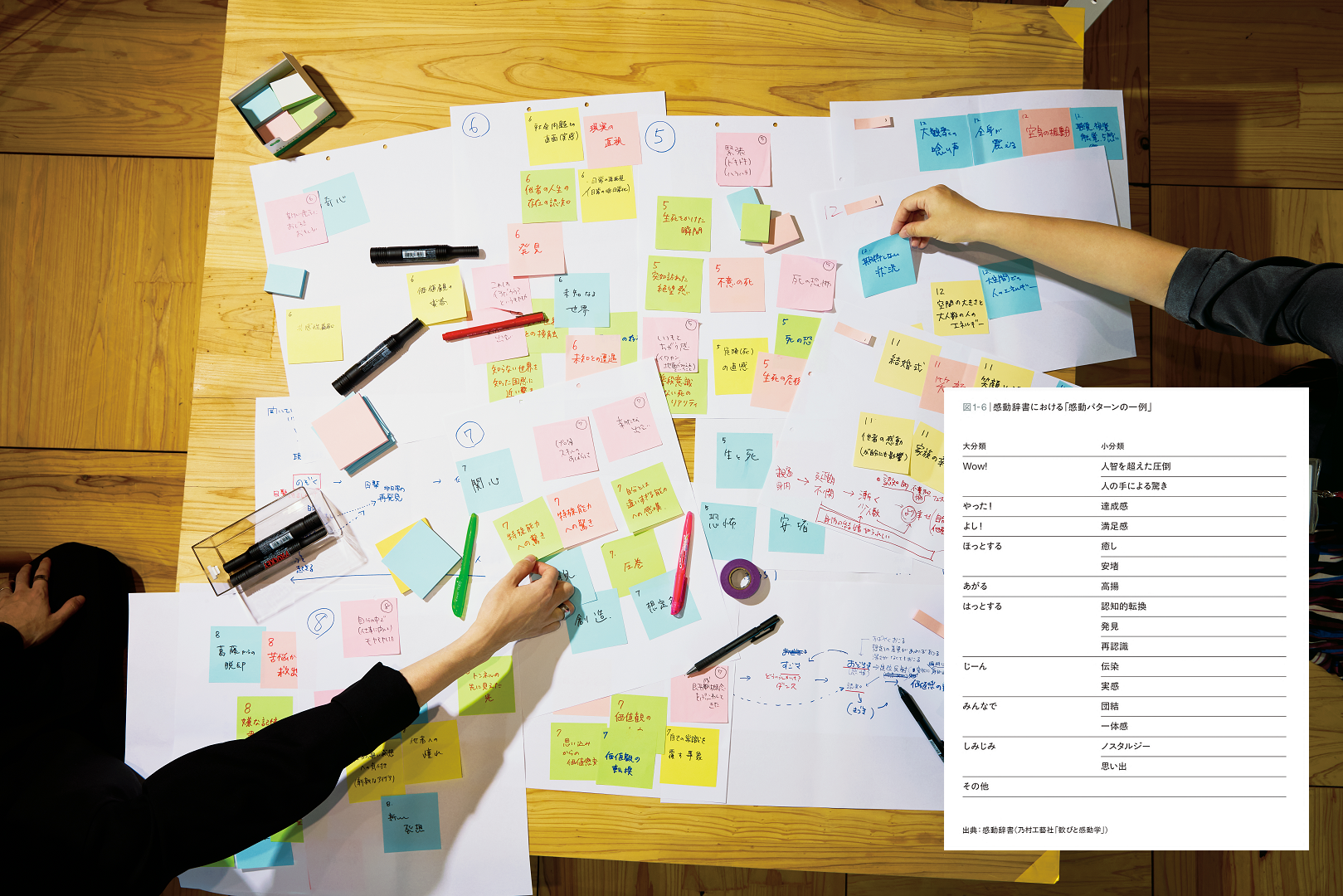
Working with Professor Aono Tokaji, we made many discoveries. To begin with, we didn't have a clear theory for what it means to refine an impression. The hypothesis that by adjusting the preconditions, a certain degree of unified emotion could be delivered was refreshing.
For example, when concept design a museum, instead of immediately creating displays rooms, a foyer space can be added between the entrance and displays rooms. Designers intuitively understand that this creates a sense of awe, as if a different world suddenly opens up when visitors enter displays rooms. However, by utilizing the processes revealed in the "Dictionary of Emotions" and refining the function and concept design of the foyer space, it may be possible to create an even higher level of emotion that resonates with everyone.
In reality, skilled designers and engineers with experience do this instantly in their minds. The "Dictionary of Inspiration" has made that process much clearer and allowed us to put it into words. For us, it feels like we've acquired an incredible treasure.
Tokaji In terms of usage, it could be used for individual skill development and new employee training. However, since it's fundamental, I think the key is how far you can leap from there and how much originality you can bring to it. I'd like to see how you can create this kind of space by changing so much from the original dictionary. It would be worth analyzing further. I think it can be applied not only to creating spaces, but also to creating content such as videos and books.
Subtle changes in emotions manifest as physiological responses.
Aono The "Emotional Profiling" team's research theme is analyzing major emotional shifts, or triggers that induce emotion. Separately, the "Emotional Measuring Stick" research team was established to explore whether there is a way to scientifically measure the emotional state before emotions are stirred and track changes in those emotions. Professor Sugaya from Shibaura Institute of Technology has joined this team. Nomura Co., Ltd. has accumulated a vast amount of completed building photographs, so this is an attempt to measure emotions by combining these with physiological indicators.
Sugaya: Originally, I was researching in the field of information science, but after caring for my parents, I started researching how to estimate emotions from biological responses. The foundation of science is to measure quantities. But emotions are invisible and have no units to represent them. Approaching something that has no units is an exciting subject because you might be the first to assign units to it. It was at that time that Nomura Co., Ltd. approached me and asked if I would like to work with them to think about a way to measure emotions using psychological models and physiological indicators, and create an "emotional measuring stick."
While Professor Tokaji and his colleagues approach the verbalization and systematization of emotions, our approach is to interpret subtle emotional changes that are not verbalized from physiological indicators and bodily responses. We use wearable devices to measure brain waves and heart rate. For example, when you see something scary, your chest tightens. Or when you see something cute, you feel warm and fuzzy. This is because the brain and autonomic nervous system are reacting. We are trying to quantify these reactions from the movements of brain waves and heart rate.
Since the goal was to create indicators, we based them on the basic emotions of "joy, anger, sorrow, and pleasure," including not only positive "excitement" but also negative emotions. However, human emotions are very complex, and while we intuitively understand that "happiness" and "relaxation" are different, the fascinating aspect of this research is whether that difference can be measured scientifically.
I'm no longer afraid of AI.
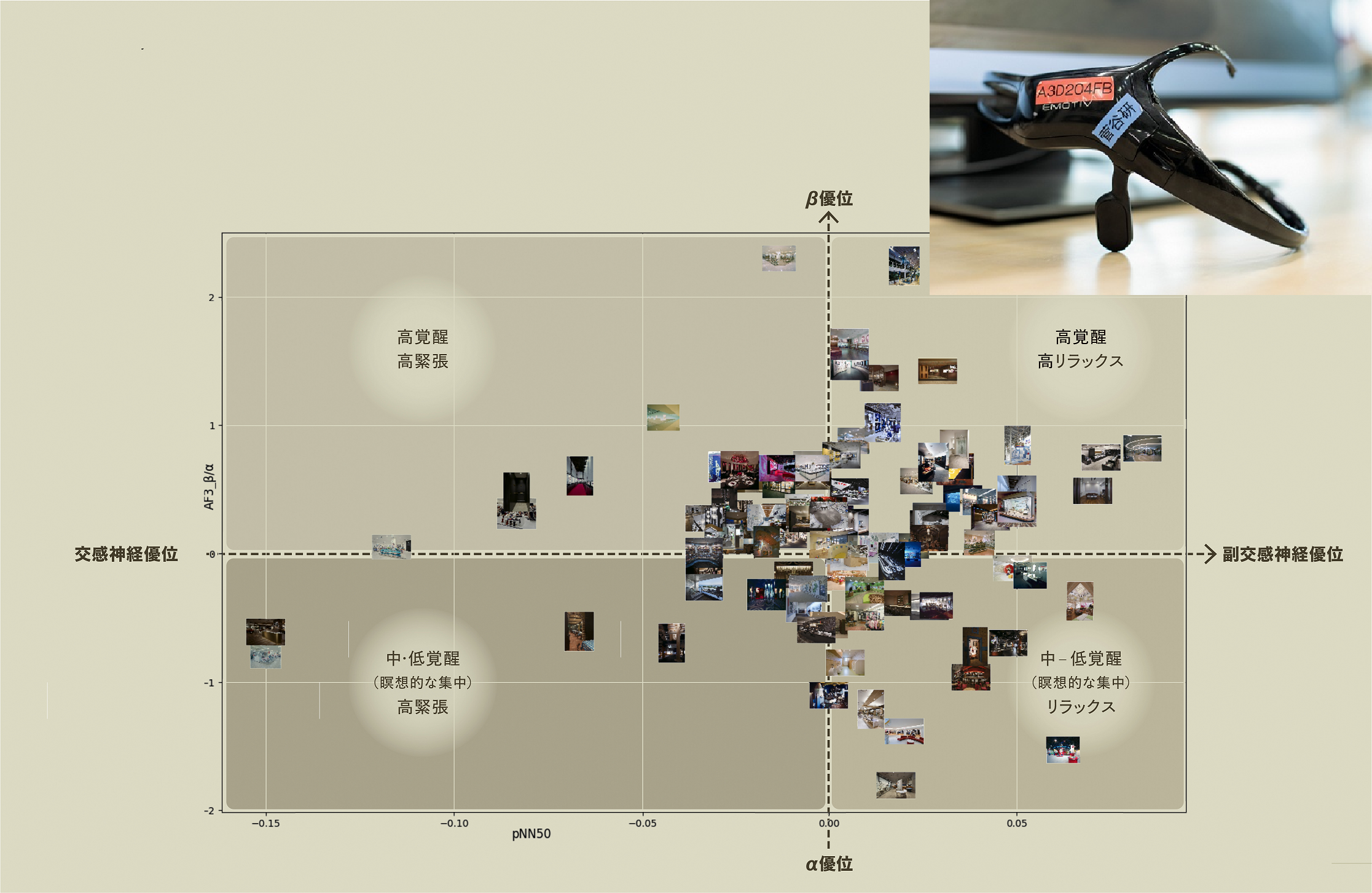
Sugaya: Specifically, we show experiment participants a selection of 100,000 completed building photos, interpret their physiological indicators (EEG and heart rate variability), and map them onto a psychological model.
For example, when a value corresponding to the fourth quadrant (meditative concentration) appeared on the map, I would check with the designer. They would then advise me on the interpretation, saying that this was the library and therefore as intended. This is how the team would check our answers together. Because it's an "emotional scale" based on physiological responses, it's important to accurately capture even responses that are difficult to explain.
We also had Professor Aono Sugaya experiment with things like how emotions change depending on the color of the space, and how reactions differ between real and virtual spatial images.
What I found interesting was the difference between men and women. The difference between men and women was greater than the difference between real and virtual reactions. We have male and female designers in our company, and they sometimes feel that "their sensibilities are somehow different." But they have a hard time putting those differences into words. Professor Sugaya's experiment made sense to me.
Sugaya: Women's physiological responses are quite diverse and dispersed. On the other hand, men's responses are not dispersed but similar. Keeping these tendencies in mind when forming teams or creating things might be a new way of thinking about diversity. Everyone is equal, and everyone is wonderful. But there are biological and physiological tendencies in what we think is good and what we don't. I think it was an interesting result.
Aono: Lately, we've also been working on projects using AI. The location we predict and the location output by the AI are quite close.
Since starting this project, I've stopped being afraid of AI. Previously, I thought it might be a threat to designers, but as long as we focus on "Delight and Passion," I feel AI can't catch up to humans. Because AI itself doesn't experience emotion, it can't create or explain things that truly move people. It can calculate and produce something that looks similar, but that's about it.
I would like to explain the basis for "Delight and Passion."
Aono Up until now, Professor Tokaji and Professor Sugaya have worked separately on this project, but from now on, if we can work together more and more, I think a different kind of synergy will begin, and the level of precision will rise to a whole new level.
Sugaya: I would like to measure the "process of creating emotion" that Professor Tokaji is using.
Tokaji: That's right. After listening to Professor Sugaya's explanation, I thought it would be good to have not just one measuring stick, but several. For intense emotions, you can use something with a wide range of scales, and for subtle emotional shifts, you can prepare several different measuring sticks with finer scales and change them accordingly. I think that way, you can measure things with much greater accuracy.
Sugaya: That's true. If you have various scales, you can increase the range of things you can measure.
Needless to say, what we asked Professor Sugaya to do was to measure the physiological response to photographs. They capture a single moment, so they can be plotted to a single emotion. However, as you move through space, your emotions are constantly changing. The question now is how to measure and plot that continuity. That will be very important when it comes to combining it with the process and patterns of emotion.
Sugaya: I really think so. We could try measuring the process of the tension you feel while waiting in the foyer suddenly being released. I think we can learn a lot by measuring over a longer period of time. When measuring, how should we think about qualitative approaches and approaches that span a little more time? I haven't done the thinking part and the part of putting it together and structuring it, so I would be very grateful if we could do it together, and I'm looking forward to it.
Aono: I don't think this project will end in a few years. As long as Nomura Co., Ltd. exists, I want this "Study of Joy and Emotion" initiative to continue. Things develop in each era, and our sensibilities will also change. If we don't update our understanding of "joy and emotion" each time, we will stray from the essential approach. Fortunately, our company has been in business for over 130 years, but in order to continue for another 130 years, this kind of initiative is necessary.
The spaces created by Nomura Kogeisha are spaces where "joy and emotion" can be explained with solid reasoning. I want to make that the norm.
(Recorded in January 2026; titles are as of the time of recording.)
Photo by Abe Ryo
profile
Akihiko TokajiToyo University
Professor, Department of Social Psychology, Faculty of Sociology
Midori SugayaShibaura Institute of Technology
Professor, Faculty of Engineering
Keita Aono,NOMURA Co.,Ltd.
Leader of the "Studies Delight and Passion" Project Team
NOMURA's Media

- NOMURA Co.,Ltd.SCENES


Please contact us using the button below if you have an inquiry, want to request a quote or request documents.
We have created a separate “FAQ page” that lists the most common questions we are asked.
Please take a look at this page if you have a question.