
Giving new value to marine plastic waste: Art-oriented recycling produces fascinating materials
- #social good
- #Sustainability

Masasuke MaseREMARE
president
Takamasa IshikawaIse-Shima Frozen
president
Goto YoshikunomuraNOMURA Co.,Ltd.
Business Production Division, Future Creation Research Institute, Head of Social Good Strategy Department
sustainability
REMARE
Toba City, Mie
Giving new value to marine plastic waste
Art-oriented recycling produces fascinating materials
Toba City in Mie Prefecture is located in a corner of the Ise-Shima National Park, which boasts a beautiful ria coastline, and is known as one of Japan's leading oyster farming areas. In 2021, REMARE was established in a location not far from Toba Bay. REMARE's focus is on recycling marine plastic waste into highly artistic materials. Although still a small company, its innovation and high level of expertise have earned it the 2023 Good concept design Award for its "Development of a Marine Plastic Recycling Plant."
Why did Limare start this initiative, and what vision does it have for the future? We asked Limare's president, Masasuke Mase, and Takashi Ishikawa, president of Ise-Shima Reito, a local fisheries company that has supported Limare since its founding, to discuss these questions with Yoshihisa Goto, head of social good strategy at NOMURA Co.,Ltd., who has been focusing on Limare's products and exploring their potential applications.
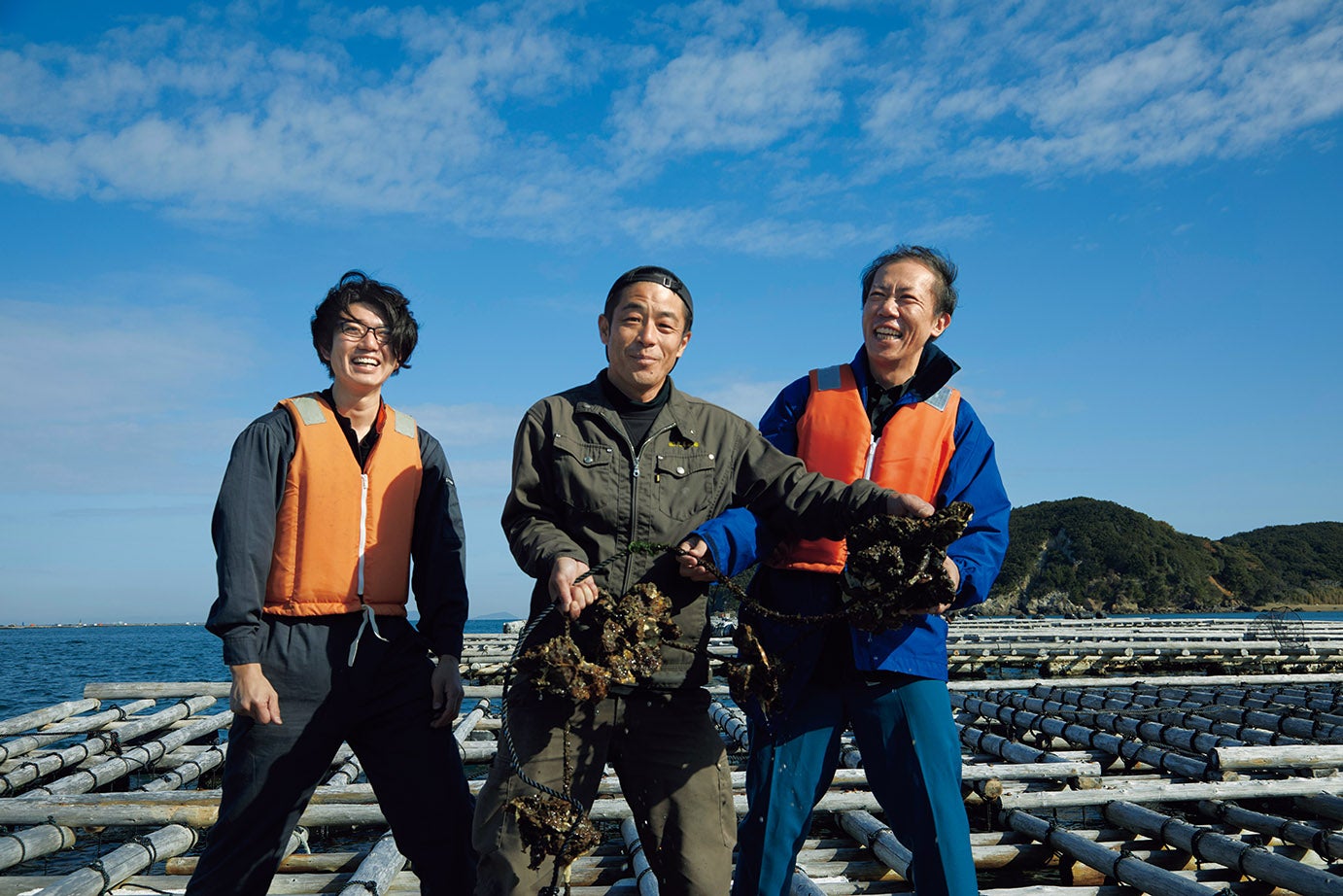
I started this job because I was a sailor.
Mase: I was originally qualified as a navigator and engineer, and served on a biological research vessel that went to the Antarctic Ocean. As we passed off the coast of the Philippines, we saw a strip of marine litter stretching as far as the eye could see, stretching toward Ogasawara and Hawaii. So, rather than researching the living things, I wanted to do something about that.
We knew that recycling marine plastic waste would not be profitable unless we built a factory on the beach and produced it locally, and we also needed the cooperation of local fishermen. But we couldn't get the locals to understand. We looked for a potential site and were turned down on Ishigaki Island, then we went south along the Kii Peninsula in Wakayama Prefecture, went around Kushimoto and went north to Toba, and suddenly they were willing to talk to us (laughs).
Ishikawa: That's because Toba is a town of aquaculture. In fisheries where fishermen go out to catch fish, they are rivals and have a somewhat closed-off temperament. However, aquaculture fishermen have long been concerned about the problem of red tides, and are very conscious of the marine environment. Aquaculture also uses a lot of plastic fishing gear.
I myself am a former salaryman who returned to Japan, but when I entered this world, I found a mountain of problems, such as the aging of fishermen, a lack of successors, and low fish prices. I want to do something about marine litter, but no one has the resources. Discarded fishing gear is piled up in the open. Then, a young man appeared who said, "Marine litter is a resource," and I immediately decided to support him.
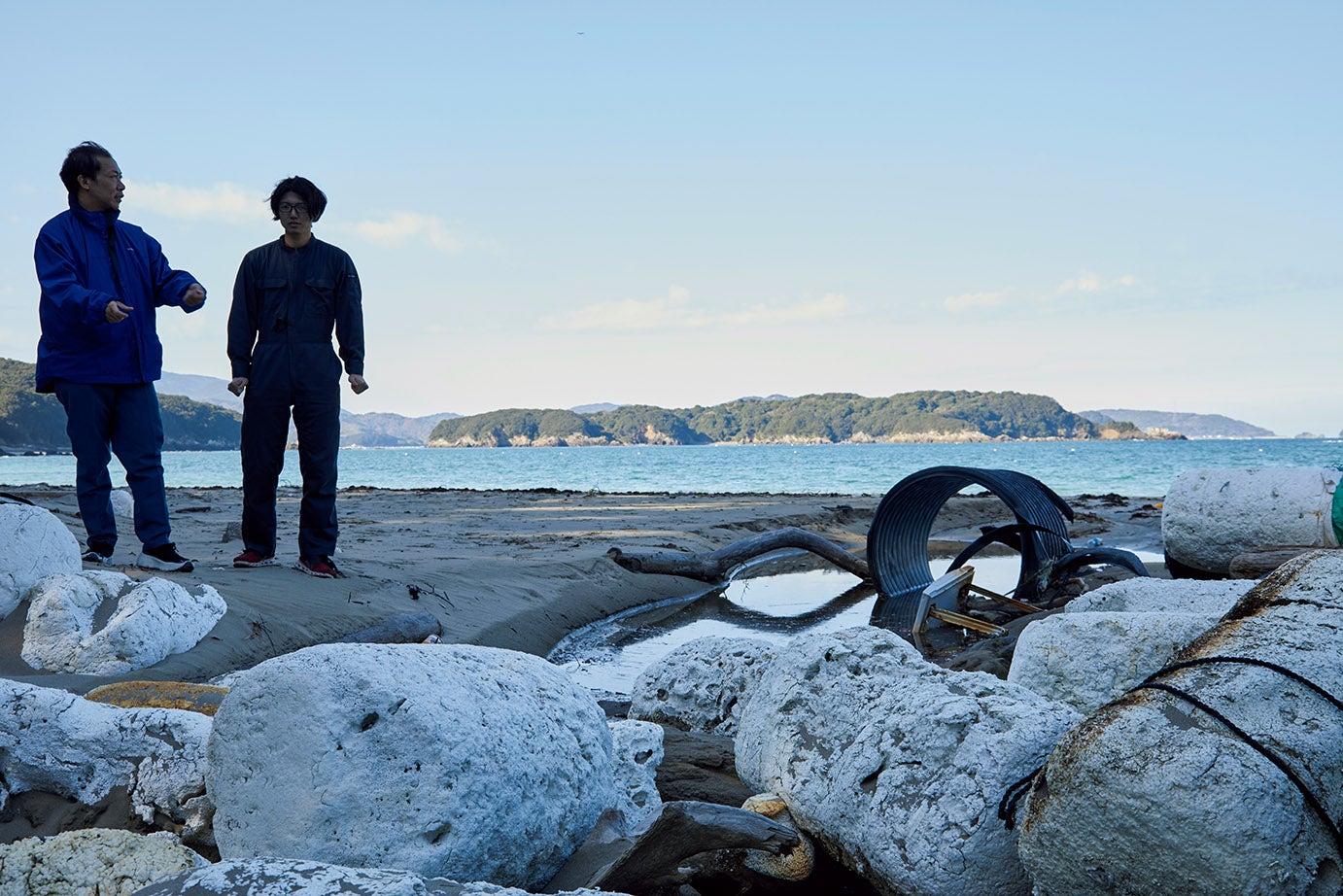
I spoke with Mr. Ishikawa Mase for about 30 minutes, and he kindly lent me a vacant seafood processing plant to use as a place to build a recycling plant. What's more, the rent and utilities were completely free for the first year. He also connected me with a network of people in the fishing industry, government officials, and university researchers, which allowed me to get started.
Even so, actually getting the business off the ground is extremely difficult. While I was on a ship, I collected marine plastic waste and did various experiments. So the processing technology itself isn't that difficult. But even though I could change the shape, it wasn't profitable. During the year or so I was struggling, I met Mr. Goto from NOMURA Co.,Ltd..
Goto: At the time, I was in charge of events such as pop-ups for foreign brands, but all events that would bring people together were canceled due to the COVID-19 pandemic. That was the trigger for me to start working on "sustainable spaces." I was watching various environmental webinars to learn more. Limare was there, and the products they showed me on screen were beautiful.
Mase: At that time, I showed them 30cm square planks, and although I was making a lot of them, I had no place to sell them. It was a typical example of product-out, and since the product was concept design oriented and art-related, I had absolutely no idea how to find people who would want it.
Goto: Later, when I met Mase-san in person and talked to him, I learned about the background of his founding, how it contributes not only to the environment but also to the local community, and how many different people are working together to make it happen. So I became a fan. Then, as I talked about it within the company, we started to see some cases where people were using it, and gradually awareness of it started to increase.
It's a "lab" where we try anything with our handmade machines.
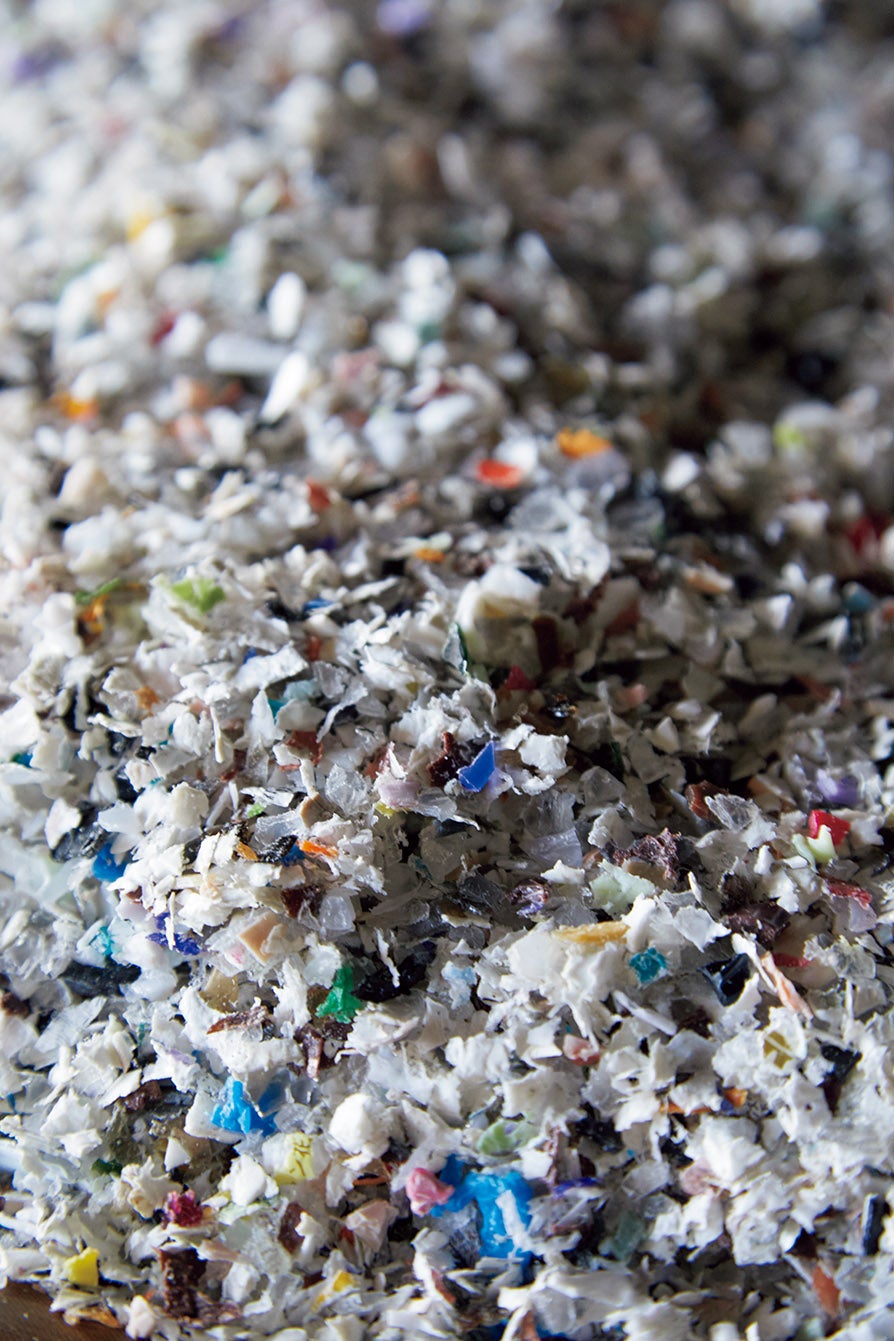
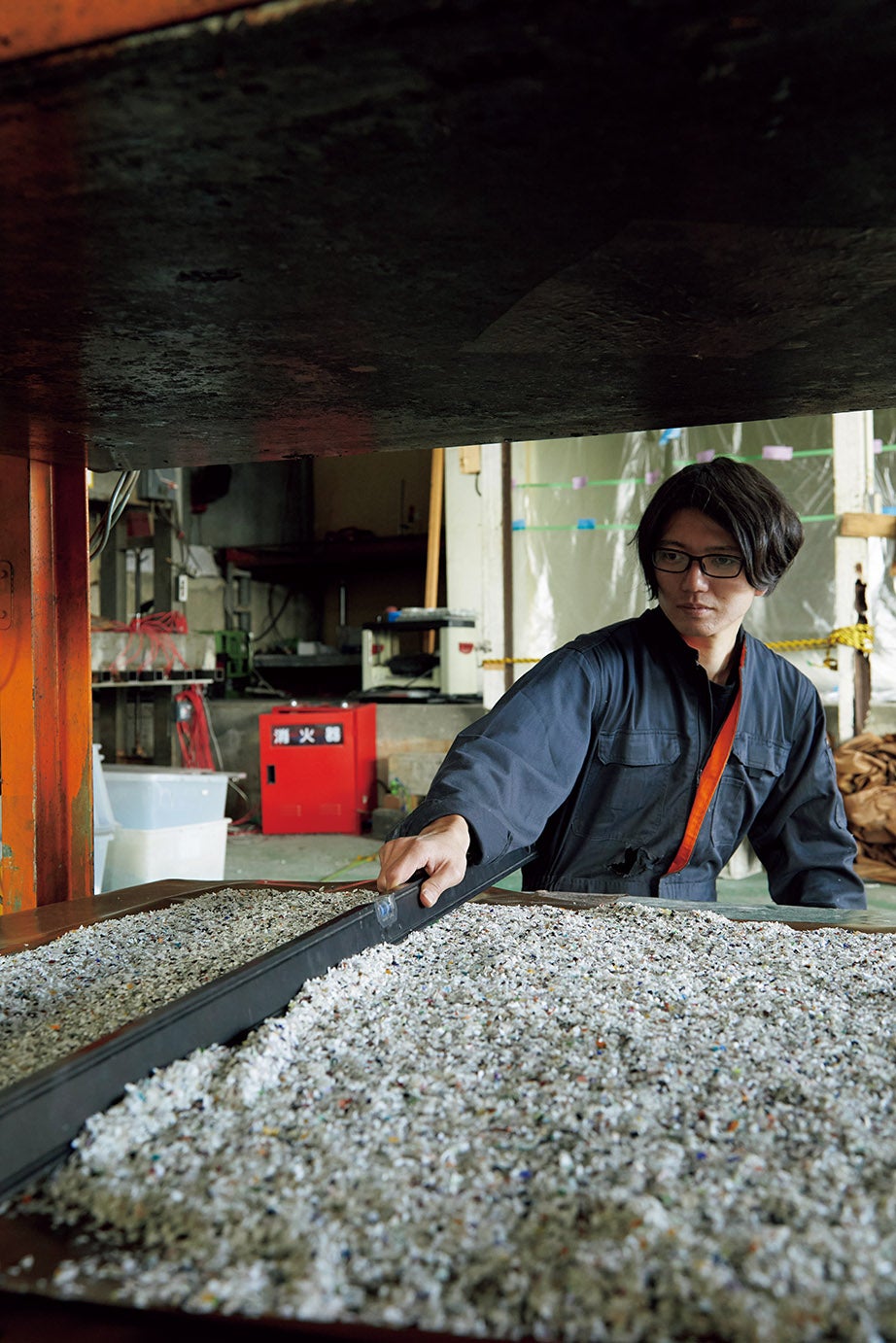
Thanks to Mr. Mase and Mr. Goto, we gradually began to see potential uses for the material, such as for fixtures, and our ideas expanded. For the board material, we use the colors of crushed waste plastic to create concept design as if we were painting art, and then mold them using a heat press. By devising different materials, color schemes, and pressing methods, we can create a variety of products. By improving the press molding machine, we can now handle larger sizes as well.
But press molding machines are expensive if you buy them normally. A new one costs around 100 million yen, and even a used one costs 40 million yen. I couldn't afford that, so I designed the heater part myself at a low cost and ordered it from a specialist, and I made all the control systems myself. In the end, I made it for 1.5 million yen. Its performance is comparable to a 100 million yen machine. Moreover, because it's cheap, we can take on challenges. Manufacturers that make industrial products have strict standards and conditions. Recycled materials are prone to contamination with foreign objects, so if nails or other things get mixed in with the crushed material and damage the press surface, the line stops. But we can repair the equipment ourselves, so we can take on challenges without hesitation. At one point, we were making prototypes until late at night in the factory, and we were able to accumulate data on temperature, heating time, and flake size for each type of resin. That data is proving to be extremely useful in product development now.
Goto: We sometimes consult with major material manufacturers to see if they can make things like this, but they require a large quantity. The amount we need to create one-of-a-kind spaces is not commensurate with what we need.
But when someone like Mase says, "Sure, let's give it a try," it's really encouraging. Because we can do it on a small scale, we can take a step forward. It fits with today's society, doesn't it?
Just the other day, I asked them to crush some artificial turf and make it into a board. Artificial turf is a composite material that contains rubber, so they usually don't accept it. But Mase-san said, "Let's crush it once. If it doesn't work, we can just clean it up, and if the machine breaks, we can just fix it." He was a very reliable person.
Mase: If you want to call it that, we're a "lab." Just like with artificial turf, each industry has its own discarded plastic. That becomes unique, and a pattern unique to that company is created. It's about recycling resources, but "interesting" comes first.
For example, ski boots are redesigned every three years, resulting in a large amount of waste. They are a composite material with aluminum fittings and fiber lining on the inside, but after removing the aluminum, they are crushed and pressed. By testing different ratios, we can find the recipe for a proper board material.
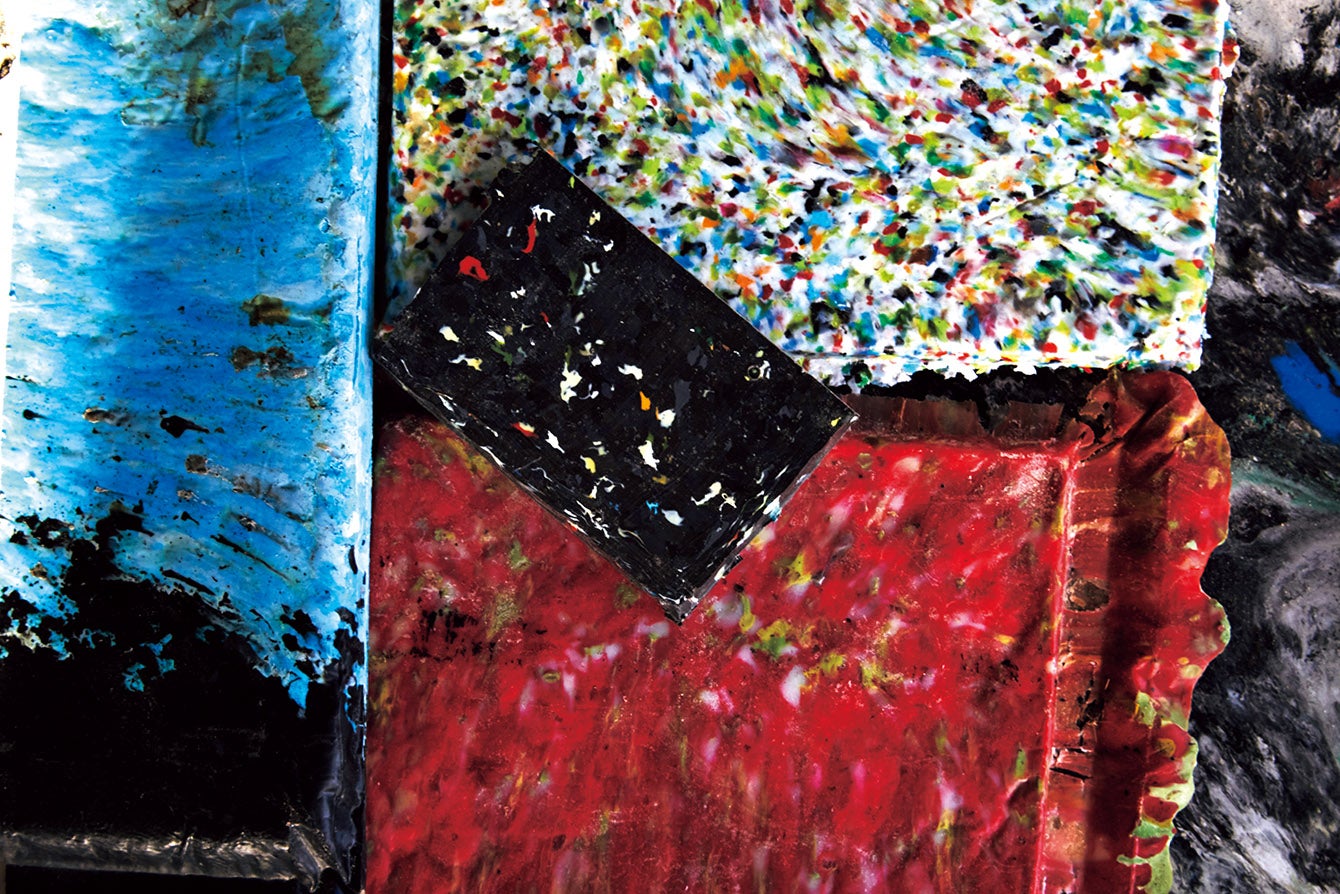
Goto:There is no industry that doesn't use plastic, and even for non-manufacturing industries, resin is always involved, for example, in the acrylic panels to prevent droplets from spreading during the COVID-19 pandemic, and in packaging materials. For customers, it is more convincing to hear that "your company's waste plastic has been recycled into this panel," than to be proposed environmentally friendly building materials whose origins are unclear.
Mase: This also has a big advantage for the waste disposal companies. Not only does it reduce the waste disposal costs that were previously incurred when throwing away plastic, but it also means that we can obtain the raw materials for almost free. This makes for a very profitable business model.
But our ultimate goal is to turn waste plastic into oil. We are currently working with a partner company to turn plastic back into petroleum. The technology has already been solved, so it's not difficult. The problem is profitability. We want to make it happen somehow using natural energy.
I think it's amazing how Goto Rimare is managing to balance both social responsibility and business viability in various ways, such as establishing a route for selling waste plastic in flake form and accepting composite plastic materials from manufacturing companies.
In the context of our spatial design business, we want to work with diverse planners and designers to utilize these building materials to create highly concept design works and foster communication through the recycling of materials.
Wanting to breathe "future abundance" into the region
Mase: Ultimately, I want to recycle general waste generated in Toba City and Shima City, transform it into products, and sell them in big cities like Tokyo. I want to concept design a system where money flows from there to here. For that, I need the cooperation of the local people.
For example, people come from far away to participate in beach cleanup events. However, the participants don't know what happens to the collected trash afterward. But if we recycle it into planks and use them as tables in a local cafe, it creates a reason for people to visit beyond just drinking coffee. I want to conduct a practical experiment based on the concept of "gastronomic geopolitics."
Ishikawa Gourmet cannot be sustained if we only pursue the deliciousness of food. We consider ecosystems, environmental conservation, and climate change, and think about delicious food for each region. That is "gourmet geopolitics." We are also conducting research on this topic together with universities, but in the end, it's about changing the supply chain. Even around Ise-Shima, climate change is causing a big change in the species of fish that can be caught, and fish from the south that have never been seen before are being landed.
This includes waste plastic, but the point is that we all need to think together, including citizens, businesses, researchers, and government, about how to put unused resources into the supply chain and how to change consumer awareness and behavior. In that sense, I think Mase's artworks can also be a catalyst for behavioral change. The immediate goal is to reduce waste, but we can use this as a starting point to change the awareness of our citizens. It's time to create new wealth in each region.
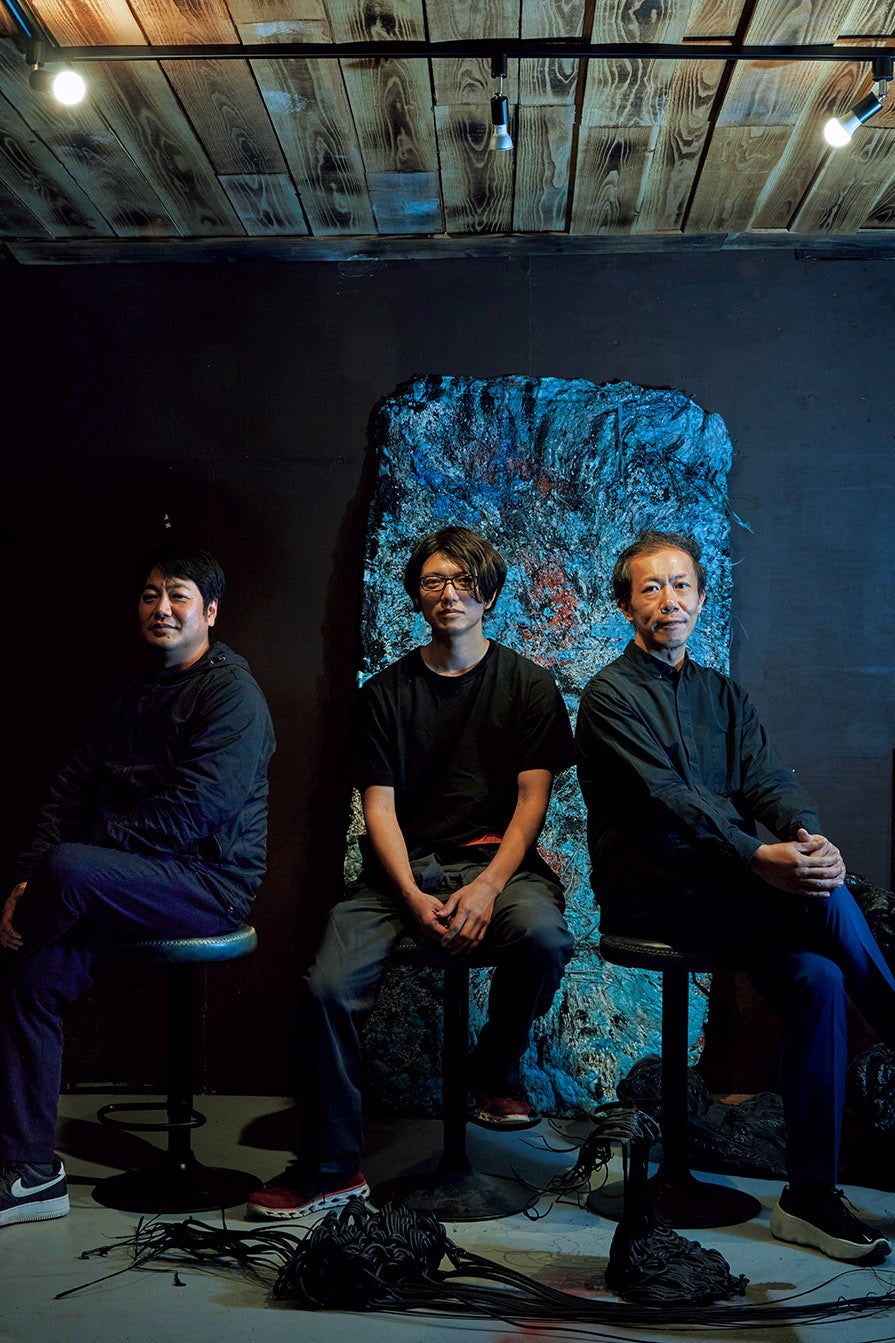
(Interviewed in December 2023. Titles in the article are those at the time of the interview.)
Photo = ©Kenta Yoshizawa
profile
Masasuke MaseREMARE
president
Takamasa IshikawaIse-Shima Frozen
president
Goto YoshikunomuraNOMURA Co.,Ltd.
Business Production Division, Future Creation Research Institute, Head of Social Good Strategy Department
NOMURA's Media

- NOMURA Co.,Ltd.SCENES


![Drawing out children's passions through numerous experiences [Part 1]](/_next/image/?url=https%3A%2F%2Fnomura-kogeisha.g.kuroco-img.app%2Fv%3D1779774440%2Ffiles%2Fuser%2FSCENES%2FVol.05%2FPandD_JUNOPARK%2F477A3016b_jitsuga.jpg%3Fwidth%3D800&w=1920&q=75)


Please contact us using the button below if you have an inquiry, want to request a quote or request documents.
We have created a separate “FAQ page” that lists the most common questions we are asked.
Please take a look at this page if you have a question.